
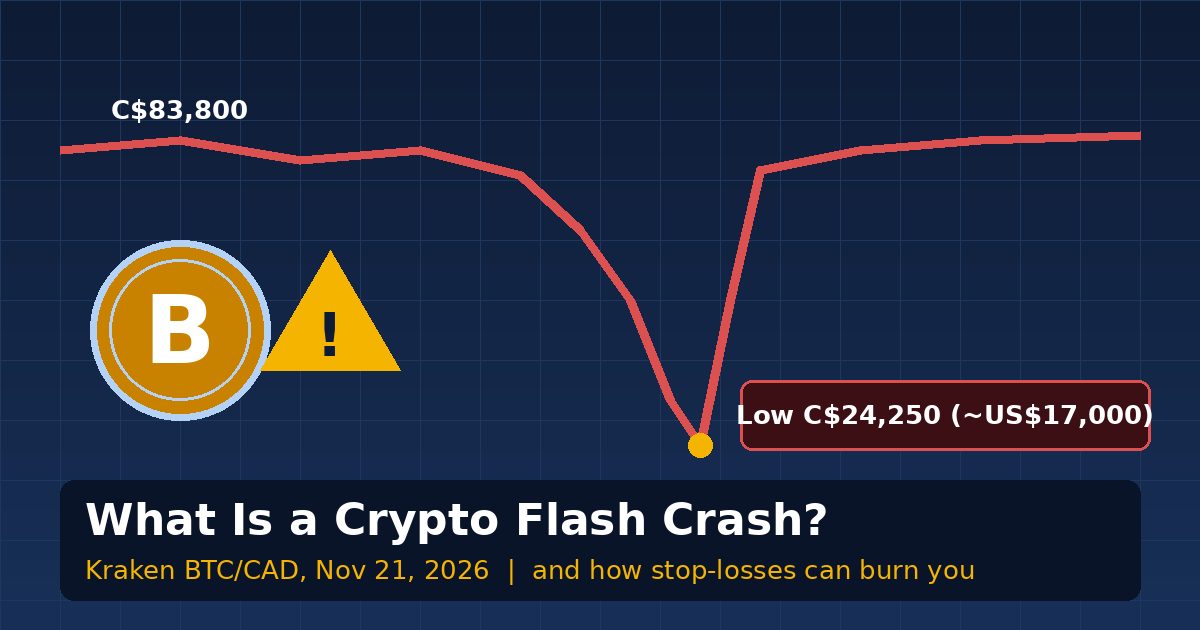
What is a crypto flash crash? A crypto flash crash is a sudden, deep price drop on one market that reverses within minutes or hours. On November 21, 2026, Bitcoin sold for C$24,250 (about US$17,000) on Kraken’s thin Canadian-dollar market while it traded near US$57,700 on Kraken’s US-dollar market. Kraken says the trades stand.
Last updated November 24, 2026. Every price and date below links to its source. This article is for education only and is not financial advice.
What is a crypto flash crash, in plain English?
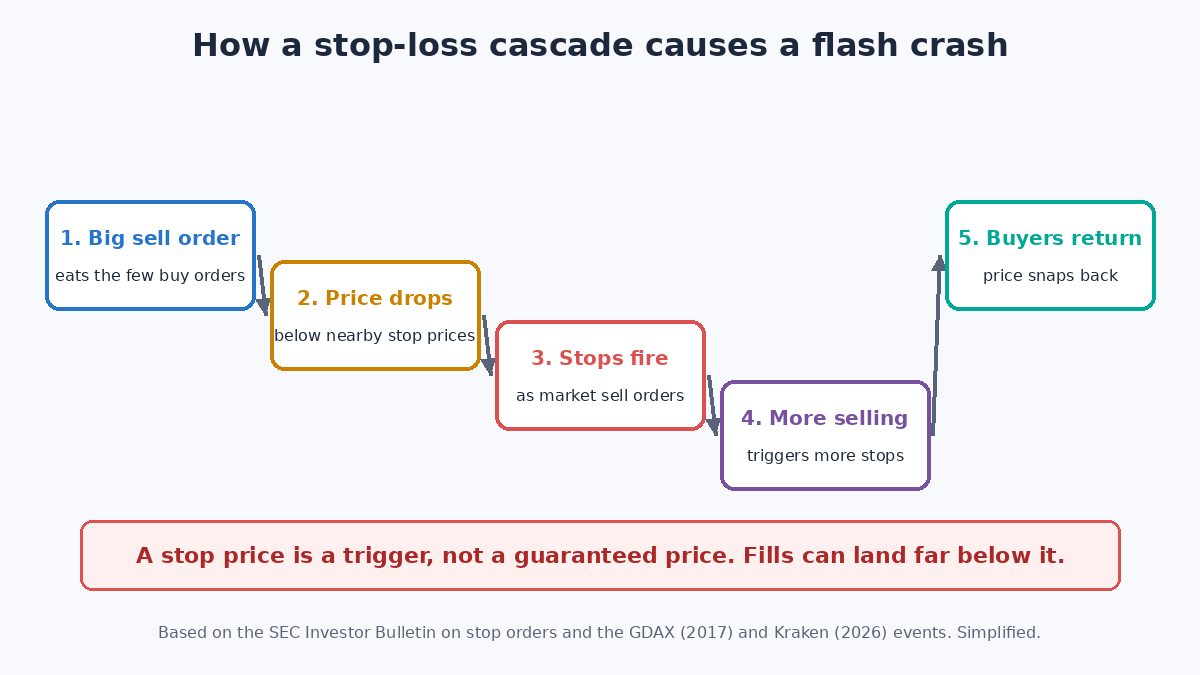
Every exchange keeps an order book: a list of buyers and sellers waiting at different prices. A “market” sell takes the best buy orders one after another until it is filled. If the list is short, a large sell eats through it and prints a price far below the coin’s real value.
That is a flash crash: not the whole market repricing Bitcoin, but one order book running out of buyers for a while. A normal correction is different: prices fall on every major exchange over days or weeks and do not snap back in minutes. Stop-loss orders make flash crashes worse, because a stop price is only a trigger. Once it is hit, the order becomes a market order and fills at whatever buyers are left (SEC Investor Bulletin).
What happened on Kraken’s Canadian-dollar market
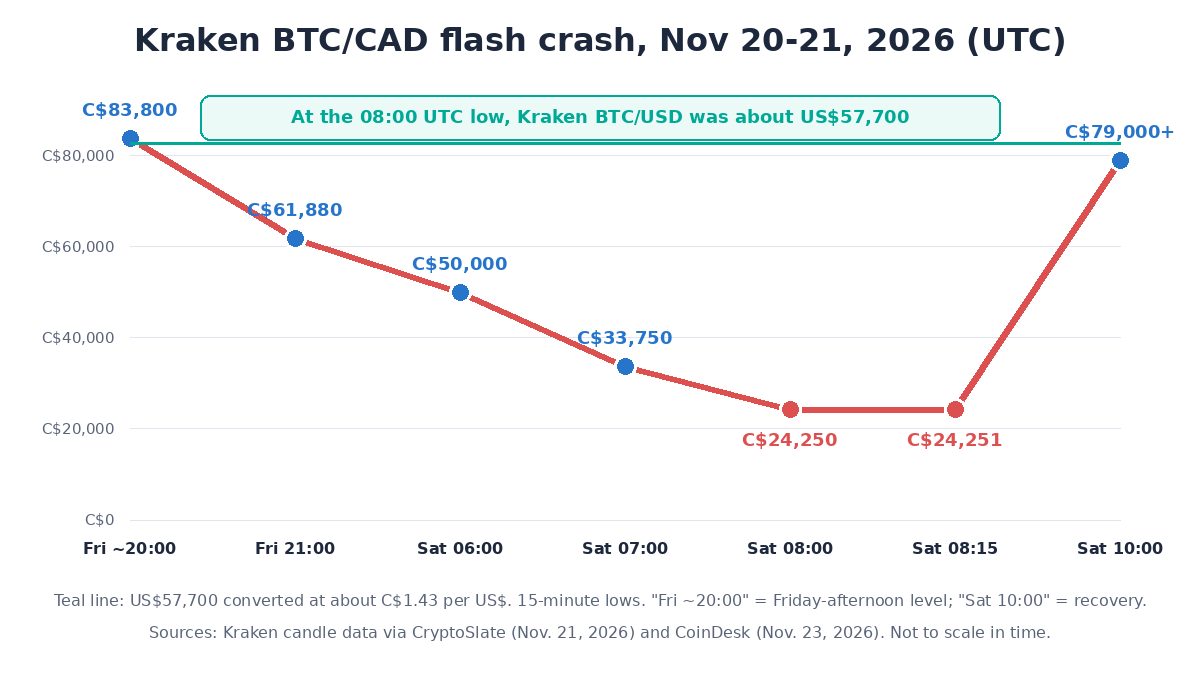
Kraken runs a separate order book for each currency, so Canadian-dollar traders only match with each other (CoinDesk). On Friday afternoon, November 20, 2026, Bitcoin traded near C$83,800 there, against roughly US$58,300 on Kraken’s US-dollar pair. Heavy selling hit the Canadian pairs around 3 p.m. ET Friday, pushing Bitcoin below C$70,000 within an hour and under C$50,000 by 7 p.m. ET.
The low came in the 15 minutes after 3 a.m. ET (08:00 UTC) on Saturday, November 21: C$24,250, across 976 trades totaling about 22.38 BTC in that window (CryptoSlate). At the same time, Bitcoin was near US$57,700 on Kraken’s US-dollar book. Other Canadian-dollar pairs fell too. Ether dropped to C$796, XRP to 41 Canadian cents, and Tether’s USDT, normally worth about C$1.43, to 56 Canadian cents (CoinDesk).
The book recovered above C$79,000 by 5 a.m. ET Saturday and was back in line with global prices on Monday, at about C$87,700 against US$61,350 (CoinDesk).
What Kraken said
At 11:12 UTC on November 21, Kraken Support posted on X: “Starting around 20:00 UTC on Nov 20, CAD pairs on Kraken saw heavy selling pressure that pushed prices well below other markets. Our platform processed every order correctly, and our security teams found no sign of a breach or compromised accounts. Executed trades stand.” (Kraken Support on X). That means buyers keep the cheap Bitcoin and sellers keep the Canadian dollars they received (Finance Magnates).
What is still unclear
- The cause. Kraken has not named one, and its status page logged no incident (CoinDesk). Blockstream CEO Adam Back wrote that Kraken’s local market maker for US dollars against Canadian dollars “ran out of money.” That is his view; Kraken has not confirmed it.
- Refunds. As of November 24, 2026 we found no announcement that Kraken will compensate sellers whose stop-losses fired.
Why flash crashes happen: four ingredients
- A thin order book. Smaller markets, such as one exchange’s Canadian-dollar pair, have far fewer resting buy orders than the main US-dollar markets.
- One large sell, or a missing market maker. Market makers post buy and sell quotes all day. If one pulls out or runs out of funds, the cushion disappears.
- Automatic orders. Stop-losses and forced liquidations of borrowed (leveraged) positions fire as the price falls, and each one adds more selling.
- Bad timing. Nights and weekends mean fewer traders are awake to buy the dip and pull the price back up.
Famous flash crashes, and who got their money back
Whether traders got money back depended on the exchange:
- May 6, 2010, US stocks. Major indexes, already down over 4%, fell another 5% to 6% in minutes. More than 20,000 trades in over 300 securities executed at prices 60% or more away from their earlier values, some at a penny (SEC and CFTC report). Many of those extreme trades were later broken, and the SEC then banned “stub quotes” (SEC).
- June 21, 2017, Ether on GDAX (Coinbase). A $12.5 million market sell triggered stop-loss orders and margin calls, and Ether briefly traded at $0.10, down from about $317.81 (GDAX, CNBC). GDAX honored the trades but credited customers whose stop-losses or margin calls fired, using company funds (GDAX update).
- 2019, Kraken’s Canadian-dollar Bitcoin market. Bitcoin briefly printed about C$101, down from about C$11,250 (NewsBTC). CoinDesk compares this year’s event to that one.
- October 10, 2025, Binance. During a sell-off with more than $19 billion of liquidations in 24 hours, Ethena’s USDe briefly fell to 65 cents on Binance (CoinDesk). Binance said it paid about $283 million to affected users (The Block).
How stop-losses can burn you in a flash crash
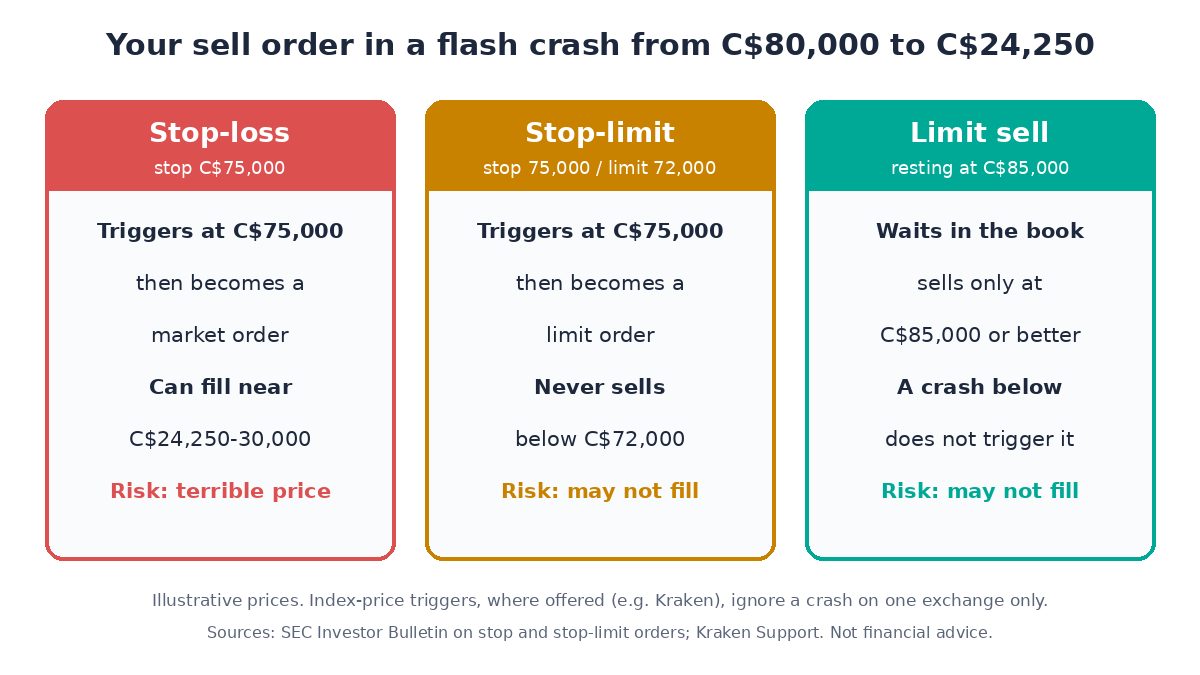
Say you hold Bitcoin on a Canadian-dollar market at C$80,000 and set a stop-loss at C$75,000 to cap your loss. In a normal decline, it sells near C$75,000. In a flash crash, the stop triggers, turns into a market order, and fills against whatever bids are left, which could be C$30,000. The SEC warns that the execution price “can deviate significantly from the stop price” (Investor.gov). Minutes later the price is back, and your coins are gone.
| Order type | What happens when the price is hit | In a flash crash | Best for |
|---|---|---|---|
| Stop-loss (stop market) | Becomes a market order and sells at the best price available | Can fill far below your stop price | Liquid markets where you must get out |
| Stop-limit | Becomes a limit order at your floor price or better | Never sells below your floor, but may not fill at all | Thin markets where price matters more than speed |
| Limit sell | Waits in the book and sells only at your price or better | Is not triggered by a crash below it | Taking profit at a set price |
| Stop with index-price trigger | Fires only if a broader market price, not just one exchange, hits the stop | A crash on one exchange alone should not trigger it | Exchanges that offer it, such as Kraken |
How to protect yourself: 6 steps
- Trade the deepest market. Before you place a stop, compare your pair’s 24-hour volume with the main US-dollar pair. A thin pair is where flash crashes happen.
- Use a stop-limit, not a plain stop. Set a floor price you would actually accept, and accept that the order might not fill.
- Choose an index trigger if offered. Kraken lets you trigger stop orders on an index price instead of its own last trade, where an index exists. Kraken says a sudden move on Kraken only would not trigger an index-based stop (Kraken Support).
- Skip leverage. Borrowed positions get liquidated automatically, often at the worst moment.
- Check another big exchange before you panic. If only one market shows the crash, it is likely a local dislocation, not a market-wide drop.
- Do not put stops on long-term coins. Coins you plan to hold for years do not need a stop at all. Our crypto trading tips for beginners cover position size and planning your exit.
Crypto trades 24 hours a day, seven days a week, so a crash can happen while you sleep. That is also true of newer 24/7 products such as tokenized stocks.
Disclosure: Some links in this article are, or may become, affiliate links. If you sign up or buy through them, Cryptolix may earn a commission at no extra cost to you. This never changes what we recommend. See our Affiliate Disclosure. This article is for education only and is not financial advice.
If you trade, use a large regulated exchange and read its order-type help pages before you set a stop. Coinbase, Kraken and Gemini all serve US customers. For coins you are not trading, a hardware wallet such as Ledger or Trezor keeps them off the exchange and away from stop-loss accidents. See our guide on whether it is safe to keep crypto on an exchange.
Checklist: before you set a crypto stop-loss
- ☐ I know which trading pair my order is on (for example BTC/USD or BTC/CAD) and how much it trades per day.
- ☐ I chose a stop-limit with a floor price I would really accept, not a plain stop market order.
- ☐ I checked whether my exchange offers an index-price trigger, and turned it on if it does.
- ☐ I am not using leverage on this position.
- ☐ I sized the position so that a bad fill would not ruin me.
- ☐ I know how to check the price on a second major exchange.
- ☐ My long-term coins are in a wallet I control, with no stop orders on them.
Video: how stop and stop-limit orders work
This short Charles Schwab explainer covers stop and stop-limit orders for stocks. The mechanics are the same on crypto exchanges.
Frequently asked questions
What is a crypto flash crash?
A crypto flash crash is a very fast, very deep price drop, usually on one exchange or one trading pair, that reverses within minutes or hours. It happens when buy orders are thin and a wave of sell orders, often automatic stop-losses, hits the order book at once.
Why did Bitcoin drop to $17,000 on Kraken?
Heavy selling hit Kraken’s separate Canadian-dollar market, which has far fewer buyers than its US-dollar market. Bitcoin fell to C$24,250, about US$17,000. Kraken has not named a cause. Blockstream’s Adam Back said a local market maker “ran out of money,” but Kraken has not confirmed that.
Will Kraken reverse the flash crash trades?
No. Kraken Support said on November 21, 2026 that its platform processed every order correctly, found no breach and that “executed trades stand.” As of November 24, 2026 we found no announcement of refunds or compensation.
Should I use a stop-loss on crypto?
A stop-loss can limit losses in a normal decline, but in a flash crash it turns into a market order and can sell far below your stop price. A stop-limit with a floor, an index-price trigger where offered, and smaller positions are safer choices.
What is the difference between a stop-loss and a stop-limit order?
A stop-loss becomes a market order when the stop price is hit, so it sells at any available price. A stop-limit becomes a limit order, so it never sells below your limit, but it may not sell at all if the price falls straight through it.
This article is for education only and is not financial advice. Crypto prices can move sharply, and exchanges can fail or decline to reverse trades.
Sources
- CoinDesk: Bitcoin sold for $17,000 on Kraken’s Canadian dollar market, and the trades stand (Nov. 23, 2026)
- CryptoSlate: Kraken says trades stand after Bitcoin sold at $24,250 Canadian (Nov. 21, 2026)
- Kraken Support on X (Nov. 21, 2026, 11:12 UTC)
- Finance Magnates: Bitcoin at $17K: How Kraken avoided Saxo’s 2015 repricing trap (Nov. 23, 2026)
- Kraken Support: Other order options (trigger signal)
- SEC Investor.gov: Stop, Stop-Limit, and Trailing Stop Orders, Investor Bulletin (updated Aug. 18, 2026)
- SEC and CFTC staff report: Findings Regarding the Market Events of May 6, 2010
- SEC: SEC approves new rules prohibiting market maker stub quotes (Nov. 8, 2010)
- GDAX (Adam White): ETH-USD Trading Update #3 (June 30, 2017)
- GDAX (Adam White): ETH-USD Trading Update #2 (June 23, 2017)
- CNBC: Ethereum price crashed from $319 to 10 cents on GDAX (June 22, 2017)
- NewsBTC: Bitcoin price flash crashes 99% on Kraken BTC/CAD (May 31, 2019)
- CoinDesk: Ethena’s USDe briefly loses peg during $19B crypto liquidation cascade (Oct. 11, 2025)
- The Block: Binance pays $283 million in compensation following Friday’s depegs (Oct. 12, 2025)