
What is the GENIUS Act? Crypto stablecoins such as USDC now have a US federal rulebook: the GENIUS Act, signed July 18, 2025. It takes effect January 18, 2027. Issuers must back every coin at least 1:1 with cash or similar safe assets, publish their reserves monthly and may not pay holders interest.
Last updated November 23, 2026. Every date and rule below links to its source. This article is for education only and is not legal or financial advice.
What is the GENIUS Act, in plain English?
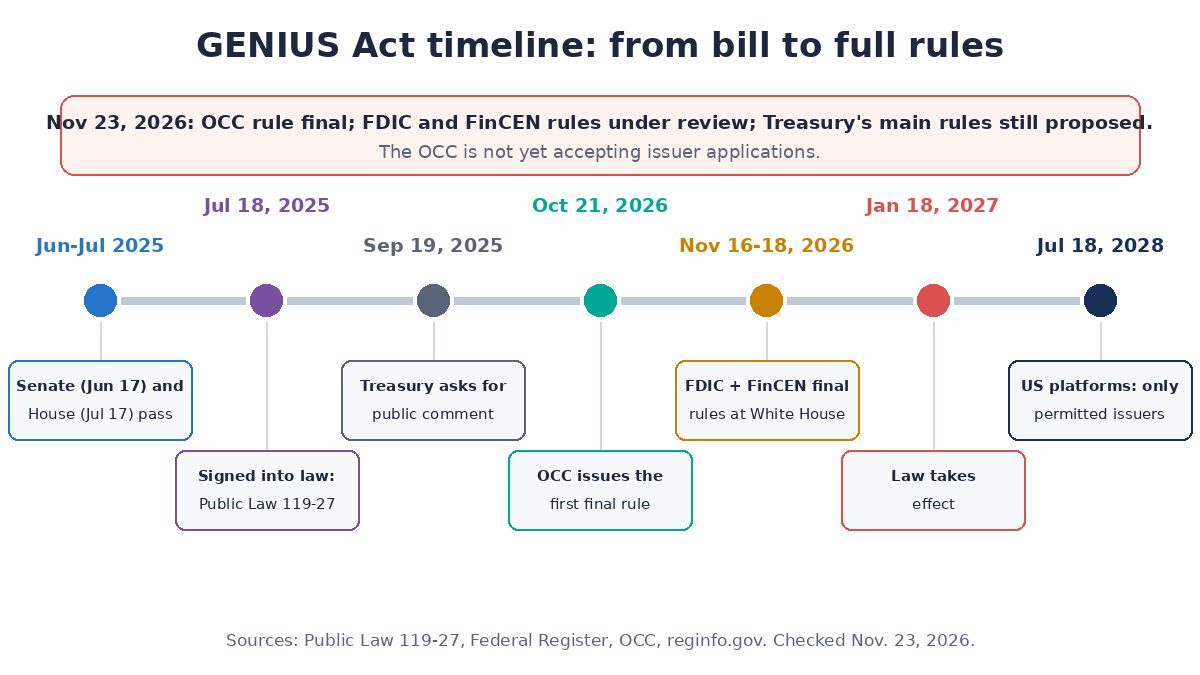
GENIUS stands for the Guiding and Establishing National Innovation for U.S. Stablecoins Act. It passed the Senate on June 17, 2025 and the House on July 17, and was signed the next day as Public Law 119-27 (statute text, Congress.gov). It is already law, not a bill.
The law covers “payment stablecoins”: tokens meant for payments that the issuer promises to redeem for a fixed amount of money, usually $1. Bitcoin is not one, and the definition excludes national currencies, securities and bank deposits, including deposits recorded on a blockchain (sec. 2). Stablecoins run on smart contracts; our guide to how smart contracts work explains the technology.
When does the GENIUS Act take effect?
Section 20 says the law starts on the earlier of two dates: 18 months after signing, or 120 days after regulators issue final rules (sec. 20). The Office of the Comptroller of the Currency (OCC) issued the first final rule on October 21, 2026, so the 18-month date comes first. The OCC confirms the effective date is January 18, 2027, the same day its rule starts (OCC Bulletin 2026-50, Federal Register).
A second date matters too. Beginning July 18, 2028, three years after signing, US crypto platforms may not offer or sell a payment stablecoin unless a permitted issuer issued it, with limited exceptions for qualifying foreign issuers (Treasury proposed rule).
What the GENIUS Act requires of stablecoin issuers
The core rules, mostly in section 4 (Public Law 119-27):
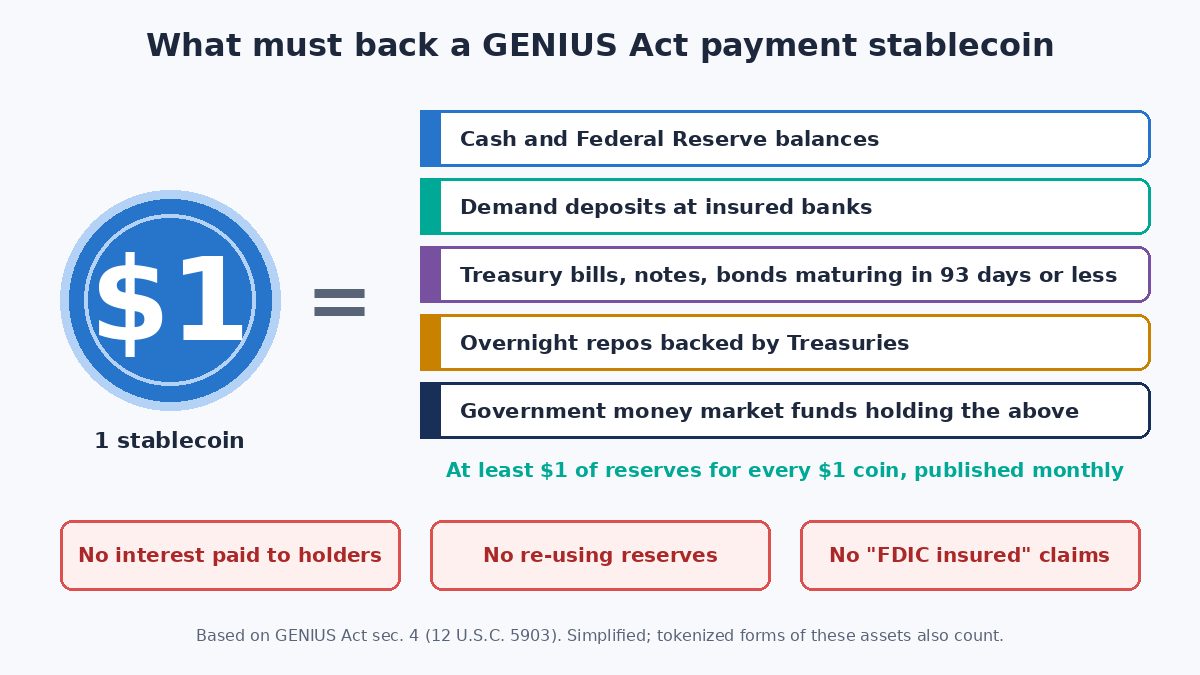
- Full reserves. At least $1 of reserves for each $1 coin, held in cash, Federal Reserve balances, demand deposits at insured banks, Treasury bills, notes or bonds maturing in 93 days or less, overnight repos backed by Treasuries, or government money market funds.
- Monthly transparency. Issuers publish the makeup of their reserves every month. A registered public accounting firm examines the report, and the CEO and CFO certify it.
- Clear redemption. Issuers must publish their redemption policy and all fees in plain language, with at least 7 days’ notice before fees change. For issuers it supervises, the OCC’s final rule caps “timely” redemption at two business days.
- No interest. Issuers may not pay holders interest or yield just for holding or using the coin.
- No re-using reserves. Reserves may not be pledged or lent out again, apart from narrow exceptions.
- No false safety claims. It is illegal to say stablecoins are backed by the US government or covered by federal deposit insurance.
- Holders first in a failure. If an issuer goes bust, holders get priority over other creditors on the required reserves.
- Not a security or commodity. A payment stablecoin from a permitted issuer is not a security under federal securities laws or a commodity under the Commodity Exchange Act.
Issuers with up to $10 billion outstanding can choose state regulation instead, if their state’s rules are certified as substantially similar.
Where implementation stands on November 23, 2026
Status of the main rules, checked today:
- Treasury: asked for public comment on September 19, 2025 (Federal Register). Its rules on state regimes (April 3, 2026) and on stablecoin issuance and sales (August 18, 2026) are still proposals (state proposal, issuance proposal). An interim rule for reviewing state certifications took effect September 30, 2026 (Federal Register).
- OCC: final rule issued October 21, 2026, effective January 18, 2027. Its GENIUS Act page says it is “not yet accepting waivers or applications” and is waiting for White House budget office approval of the forms (OCC).
- FDIC and FinCEN: the FDIC’s issuer rule and the FinCEN anti-money-laundering rule for issuers reached the White House Office of Information and Regulatory Affairs on November 16 and November 18, 2026, and show as “Pending Review” (reginfo.gov).
- Federal Reserve: proposed its rules on September 29, 2026, with comments due November 30 (Federal Register).
Existing issuers with a substantially complete application pending by January 18, 2027 can ask the OCC for a waiver of up to 12 months (OCC Bulletin 2026-51). The open fight is over state-licensed issuers. On November 17, 2026, Senators Cynthia Lummis, Kirsten Gillibrand and four colleagues asked Treasury for a similar safe harbor for issuers in states that will have a framework before January 18, 2028 (letter).
Does the GENIUS Act make USDT or USDC illegal?
No. The law never names a coin. It sets rules for issuers, and coins from issuers that never qualify lose access to US platforms over time.
- USDC: Circle received final OCC approval on July 10, 2026 for a national trust bank, Circle National Trust. Circle says it may later manage the USDC reserve (Circle). That charter is not the same as GENIUS Act issuer approval, which the OCC has not started granting.
- USDT: Tether launched a separate US coin, USA₮, on January 27, 2026. Anchorage Digital Bank, N.A. issues it. Tether says USD₮ keeps operating globally while “progressing towards GENIUS Act compliance” (Tether).
- Your own wallet: the platform rules in section 3 do not apply to direct person-to-person transfers or to transactions through a software or hardware wallet you control (sec. 3(h)).
Payment stablecoin vs tokenized deposit vs unregulated stablecoin
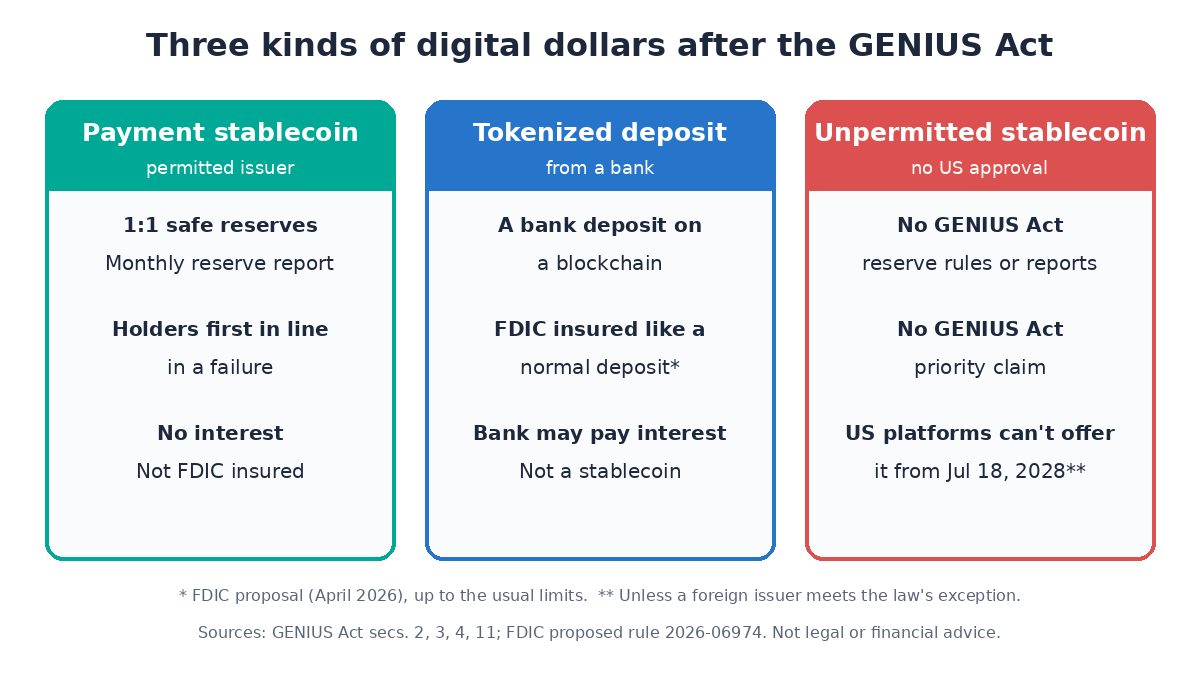
| Payment stablecoin (permitted issuer) | Tokenized deposit (bank) | Stablecoin without US approval | |
|---|---|---|---|
| What it is | A token redeemable for $1, issued by an approved issuer | A normal bank deposit recorded on a blockchain | A dollar token from an issuer outside the GENIUS Act system |
| Backing | At least 1:1 safe, liquid reserves, reported monthly | The bank’s balance sheet, like any deposit | Whatever the issuer says; no GENIUS Act rules |
| FDIC insurance for you | No (reserve deposits are insured to the issuer, not to you, under the FDIC proposal) | Yes, up to the usual limits, under the FDIC proposal | No |
| Interest | Issuer may not pay it | Bank may pay it, like any deposit | Not covered by the law |
| If the issuer fails | Holders have priority on the reserves | Normal bank failure rules | No GENIUS Act priority |
| Can US platforms offer it? | Yes | Yes (it is a deposit, not a stablecoin) | Not from July 18, 2028, unless a foreign exception applies |
The FDIC’s April 2026 proposal says a tokenized product that meets the legal definition of a deposit “is a deposit” with the same insurance coverage (FDIC proposal). The final version is under review, so this could change. For tokenized Treasuries and other assets, see our guide to real world asset tokenization.
What the GENIUS Act means for you as a stablecoin holder
Nothing happens to your coins overnight on January 18, 2027. What changes is the protection behind the coin you choose:
- Check who issues your stablecoin and whether it has applied for, or received, US approval.
- Read the issuer’s monthly reserve report once it starts publishing under the new rules.
- Do not expect interest from the issuer. If a platform offers rewards, read who pays them and why.
- Know your platform’s plans for coins that are not permitted before July 18, 2028.
Disclosure: Some links in this article are, or may become, affiliate links. If you sign up or buy through them, Cryptolix may earn a commission at no extra cost to you. This never changes what we recommend. See our Affiliate Disclosure. This article is for education only and is not financial advice.
If you want to buy or hold USDC, established US exchanges such as Coinbase and Kraken list it. Coins left on an exchange depend on that company; see our guide on whether it is safe to keep crypto on an exchange. For larger amounts, a hardware wallet such as Ledger or Trezor lets you hold the coins yourself. Transactions through a wallet you control are exempt from the law’s platform rules.
Checklist: before you hold stablecoins in 2027
- ☐ I know which company issues each stablecoin I hold.
- ☐ I checked whether that issuer is approved, or has applied, under the GENIUS Act.
- ☐ I know a stablecoin is not FDIC insured, even when its reserves sit in a bank.
- ☐ I ignore any pitch that calls a stablecoin “government backed” or “FDIC insured.”
- ☐ I am wary of high “yield” offers on stablecoins and know the issuer cannot pay interest.
- ☐ I know my exchange’s plan for coins without US approval before July 18, 2028.
- ☐ I keep larger amounts in a wallet I control and back up my recovery phrase offline.
Video: how stablecoins and the GENIUS Act work
In this June 2025 CBS News segment, recorded before the law was signed, Dante Disparte of Circle, which issues USDC, explains how stablecoins work.
Frequently asked questions
What does the GENIUS Act stand for, and did it already pass?
It stands for the Guiding and Establishing National Innovation for U.S. Stablecoins Act. Yes, it passed. The Senate approved it on June 17, 2025, the House on July 17, and it was signed on July 18, 2025, as Public Law 119-27.
When does the GENIUS Act take effect?
January 18, 2027. The law starts on the earlier of 18 months after signing or 120 days after regulators issue final rules. The first final rule came on October 21, 2026, too late to beat the 18-month date.
Does the GENIUS Act make USDT or USDC illegal?
No. The law does not ban any named coin. From January 18, 2027, issuing a stablecoin in the US requires approval. From July 18, 2028, US platforms may only offer stablecoins from permitted issuers or qualifying foreign issuers.
Can a stablecoin issuer pay interest under the GENIUS Act?
No. Permitted issuers may not pay holders interest or yield, in cash, tokens or anything else, just for holding or using the coin. Payments routed through an agent on the issuer’s behalf are also banned, according to the OCC.
What’s the difference between a payment stablecoin and a tokenized deposit?
A payment stablecoin is a token backed by reserves and is not FDIC insured. A tokenized deposit is a bank deposit recorded on a blockchain. The FDIC has proposed that it get the same deposit insurance as any other deposit.
This article is for education only and is not legal or financial advice. Stablecoins can lose their peg, and issuers and platforms can fail.
Sources
- Public Law 119-27, GENIUS Act, 139 Stat. 419 (July 18, 2025), via GovInfo
- Congress.gov: S.1582, GENIUS Act
- OCC Bulletin 2026-50: GENIUS Act Regulations, Final Rule (Oct. 21, 2026)
- Federal Register: OCC final rule implementing the GENIUS Act, 91 FR 67000 (Oct. 23, 2026)
- OCC Bulletin 2026-51: GENIUS Act Waivers and Application Submission Guidance (Oct. 21, 2026)
- OCC: GENIUS Act page (checked Nov. 23, 2026)
- Federal Register: Treasury ANPRM, GENIUS Act Implementation (Sept. 19, 2025)
- Federal Register: Treasury proposed rule on state regimes (Apr. 3, 2026)
- Federal Register: Treasury proposed rule on payment stablecoin issuance, offer and sale, 91 FR 53368 (Aug. 18, 2026)
- Federal Register: Stablecoin Certification Review Committee interim final rule (Sept. 30, 2026)
- Federal Register: FDIC proposed rule on GENIUS Act requirements and tokenized deposits (Apr. 10, 2026)
- Federal Register: Federal Reserve proposed rule under the GENIUS Act (Sept. 29, 2026)
- reginfo.gov: rules under EO 12866 review, FDIC RIN 3064-AG19 and FinCEN RIN 1506-AB73 (checked Nov. 23, 2026)
- Letter from Sens. Lummis, Gillibrand and colleagues to Treasury Secretary Bessent (Nov. 17, 2026)
- Circle: final OCC approval to establish a national trust bank (July 10, 2026)
- Tether: launch of USA₮ (Jan. 27, 2026)