
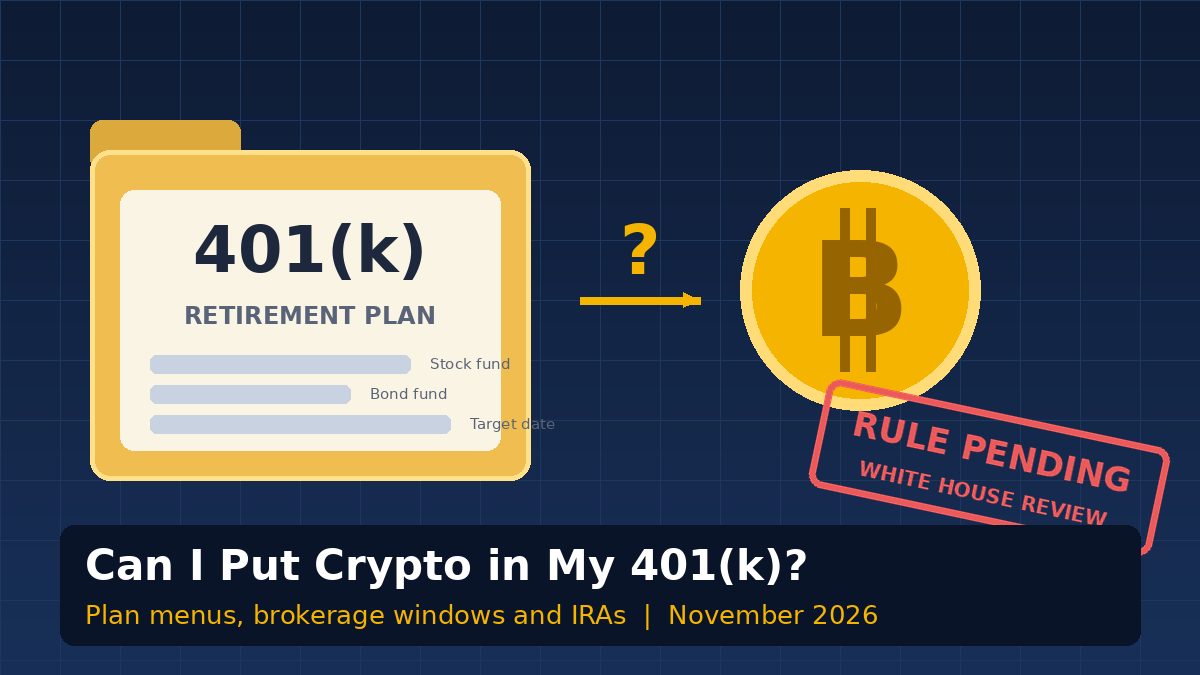
Can I put crypto in my 401(k)? Only if your employer’s plan offers a way to do it. Most 401(k)s limit you to a menu the employer picked. As of November 22, 2026, the Labor Department’s final rule is still under White House review. It is not in effect, and it would not force any employer to add crypto.
Last updated November 22, 2026. Every rule, date and limit below links to its source. This article is for education only and is not financial, tax or legal advice.
The short answer, in plain English
A 401(k) is not an account where you can buy anything. Your employer, as the plan’s fiduciary, chooses the funds. The IRS notes there is “no list of approved investments” for retirement plans, but the people running the plan must invest with the care of a prudent investor (IRS). So the real question is whether your plan has added a crypto option or a brokerage window that allows crypto funds.
For most workers today, it has not. You can still get crypto exposure through an IRA or a taxable account, compared below.
Where the Labor Department rule stands on November 22, 2026
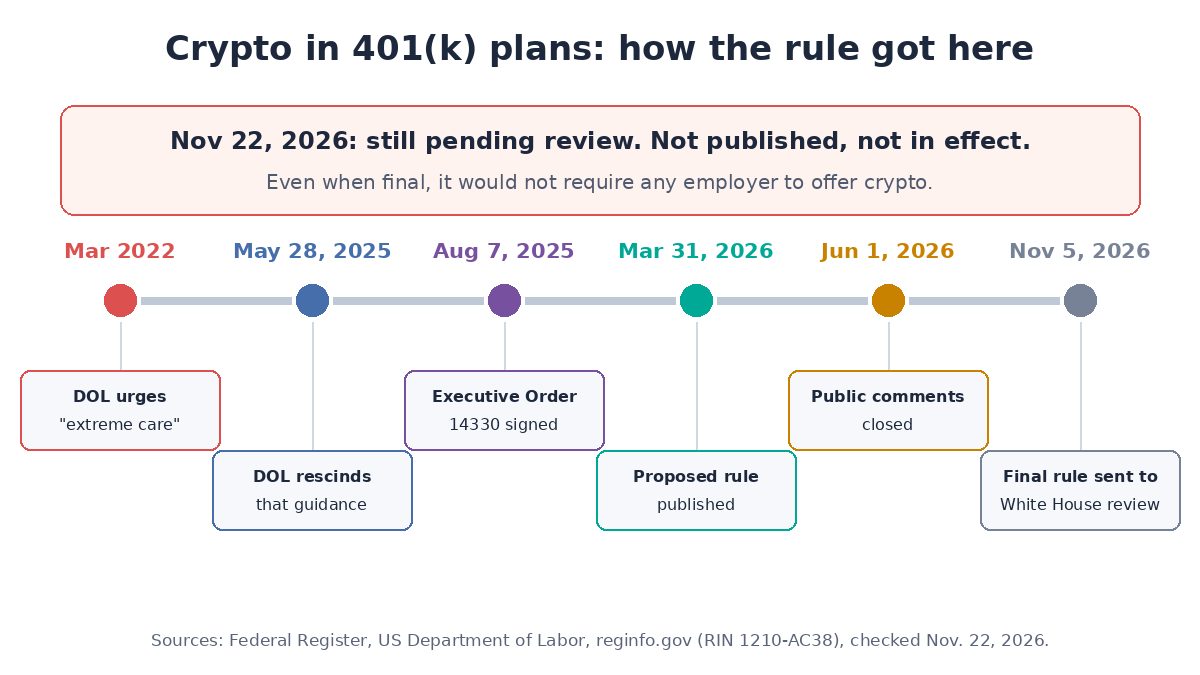
The timeline, checked against official sources today:
- March 10, 2022: the Labor Department told plan fiduciaries to use “extreme care” before adding a crypto option to a 401(k) menu (DOL).
- May 28, 2025: it rescinded that guidance and returned to a neutral approach that neither endorses nor disapproves of plans that add crypto (DOL Compliance Assistance Release 2025-01).
- August 7, 2025: President Trump signed Executive Order 14330, “Democratizing Access to Alternative Assets for 401(k) Investors” (Federal Register).
- March 31, 2026: the department published its proposed rule, “Fiduciary Duties in Selecting Designated Investment Alternatives” (RIN 1210-AC38). Comments closed June 1, 2026 (Federal Register).
- November 5, 2026: the White House Office of Information and Regulatory Affairs (OIRA) received the final rule for review. On November 22, reginfo.gov still lists it as “Pending EO 12866 Regulatory Review,” economically significant, with no legal deadline (reginfo.gov).
A search of the Federal Register today found the March proposal but no final rule. So the final rule has not been published and has no effective date yet. Industry press expects it to take effect around the end of the first quarter of 2027, but that is a forecast, not a date in any official document (401k Specialist).
What the rule would change, and what it would not
The final text is not public, so this describes the March 2026 proposal. It would give plan fiduciaries a “safe harbor,” meaning legal protection if they follow a documented process when choosing funds. They would weigh six factors: performance, fees, liquidity, valuation, performance benchmark and complexity (proposed rule).
- It would not require crypto. The proposal says ERISA “does not require or restrict any specific type” of plan investment. Your employer still decides.
- It names digital assets, but cautiously. It says there is no blanket rule against funds “investing in digital assets.” That wording is about funds, not coins you hold directly.
- It does not cover brokerage windows. The proposed definition excludes “brokerage windows” and “self-directed brokerage accounts.” Anything you buy there is your own pick.
- It could still change. The final version may differ from the proposal.
Four ways to get crypto exposure with retirement money
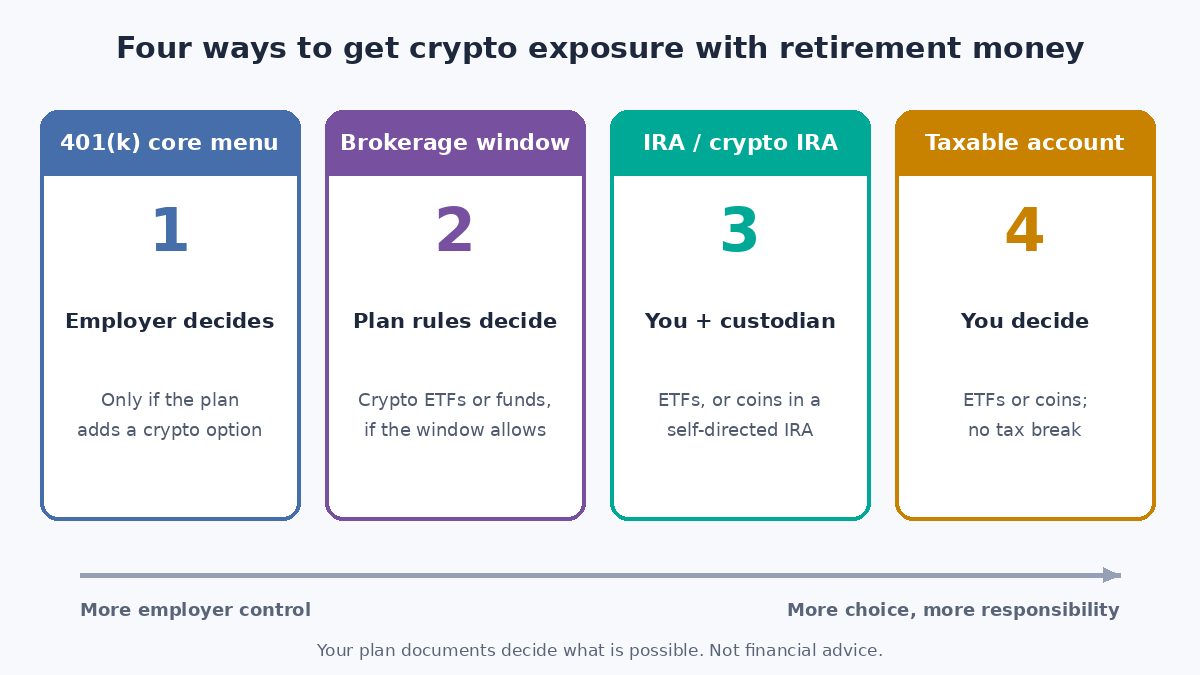
These are the main routes, from most employer control to least.
1. Your 401(k)’s core menu
A few plans already offer crypto on the main menu. Fidelity launched its Workplace Digital Assets Account in 2022, letting employers add bitcoin to the core 401(k) lineup, with the employer setting contribution limits (Fidelity). Employers must choose to offer it, and at launch Fidelity capped allocations at 20% of a balance, with employers able to set a lower cap (CNBC). If you do not see such an option, your plan does not offer it.
2. A brokerage window
Some plans include a self-directed brokerage window that lets you buy stocks and ETFs beyond the menu. The SEC approved spot bitcoin ETFs for US exchanges on January 10, 2024 (SEC). Whether your window can hold one depends on plan rules. For example, a 2023 Schwab PCRA fact sheet says participants cannot buy cryptocurrency directly but may buy funds and ETFs holding blockchain-related investments if plan trading rules allow (Schwab PCRA fact sheet).
3. An IRA, including a Roth IRA
An IRA you open yourself gives you more choice. Many brokerage IRAs can hold spot bitcoin ETFs, and specialist “crypto IRAs” are usually self-directed IRAs that hold coins. The IRA contribution limit is $7,500 for 2026 and stays $7,500 for 2027 (IRS). Self-directed IRA custodians do not evaluate the quality or legitimacy of your investments (Investor.gov). The CFTC also warns that “the IRS does not approve or review investments for IRAs,” so an “IRS approved” pitch is a red flag (CFTC).
4. A regular taxable account
You can also buy crypto with money outside retirement accounts. There is no tax break, and the IRS treats digital assets as property, so selling or swapping them can create a taxable gain or loss you must report (IRS). For storage and custody risks, read our guide on whether it is safe to keep crypto on an exchange.
Disclosure: Some links in this article are, or may become, affiliate links. If you sign up or buy through them, Cryptolix may earn a commission at no extra cost to you. This never changes what we recommend. See our Affiliate Disclosure. This article is for education only and is not financial advice.
If you go this route, established US exchanges such as Coinbase and Kraken are common on-ramps, and tax tools such as Koinly or CoinLedger can import your trade history for your tax forms. They do not replace a tax professional.
401(k) menu vs brokerage window vs crypto IRA vs taxable account
| 401(k) core menu | 401(k) brokerage window | IRA or crypto IRA | Taxable account | |
|---|---|---|---|---|
| Who decides what you can buy | Your employer (plan fiduciary) | Plan rules, then you | You and the custodian | You |
| Crypto you can usually get | Only an option the plan adds | Crypto ETFs or funds, if allowed | ETFs in a brokerage IRA; coins in a self-directed IRA | ETFs or coins |
| Tax treatment | Tax-deferred (or Roth) | Tax-deferred (or Roth) | Tax-deferred or Roth | Gains taxed when you sell or swap |
| 2026 contribution limit | $24,500 of your own pay | Part of the same 401(k) limit | $7,500 (under age 50) | No limit |
| Main catch | Most plans do not offer crypto | Not every plan has one; fees vary | Custodian does not vet; scam risk | No tax break; you track every trade |
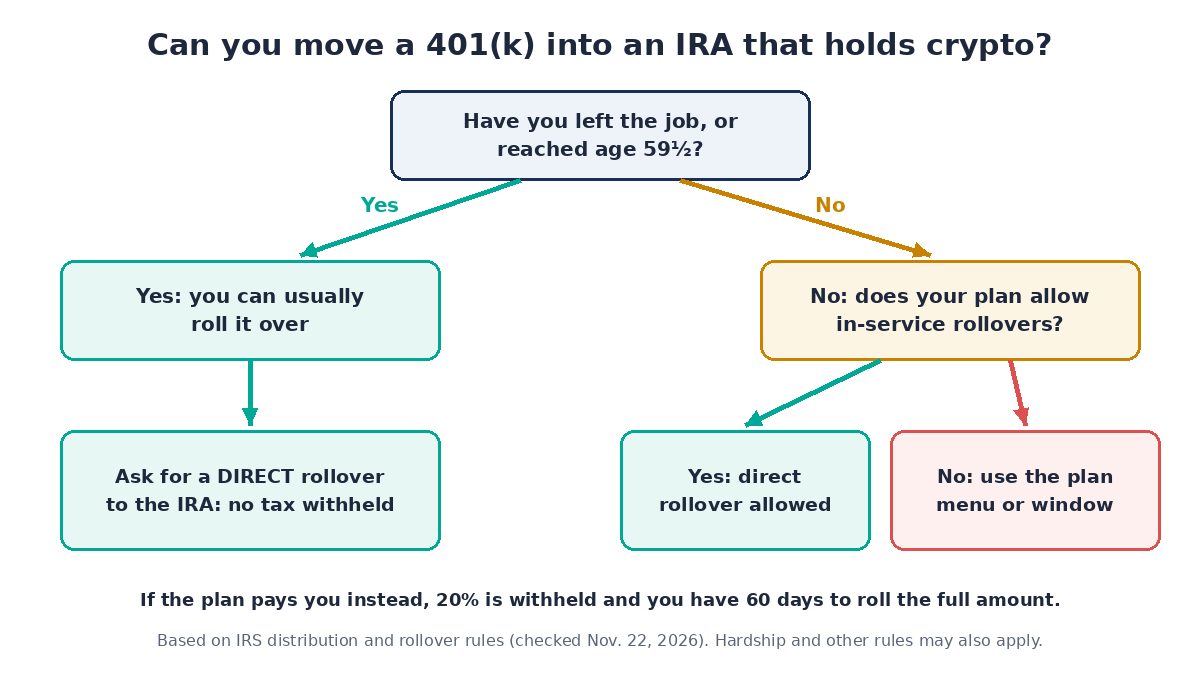
Can I roll my 401(k) into a crypto IRA while I’m still employed?
Usually not until you are 59½. Under IRS rules, your own 401(k) contributions generally cannot be paid out until you leave the job, become disabled, die, the plan ends, you reach age 59½ or you have a financial hardship (IRS). Some plans permit in-service rollovers at 59½, so check yours.
When you can move money, ask for a direct rollover to the new IRA. No tax is withheld that way. If the plan pays you instead, it must withhold 20%, and you have 60 days to deposit the full amount in an IRA (IRS).
How to find out what your plan allows
- Log in to your 401(k) and open the full investment list.
- Look for a crypto option such as a digital assets account, or for a “self-directed brokerage” or “brokerage window” link.
- Read the plan documents. The summary plan description and fee disclosure say what a window can hold and cost.
- Ask your plan administrator or HR whether crypto ETFs are allowed and whether in-service rollovers are permitted.
- Compare costs with an IRA or a taxable account before deciding.
The rule also covers other “alternative assets” such as private markets and real estate. For a related trend, see our explainer on real world asset tokenization.
Checklist: before you put retirement money into crypto
- ☐ I checked whether my 401(k) offers a crypto option or a brokerage window.
- ☐ I am not counting on the Labor Department rule; it is not final yet.
- ☐ I am keeping any crypto share small enough that a big drop would not wreck my retirement plan.
- ☐ I am not putting retirement money into a single small coin because of hype.
- ☐ I compared fees for the 401(k) window, an IRA and a taxable account.
- ☐ I ignored any pitch that calls an investment “IRS approved.”
- ☐ If I roll money over, I will ask for a direct rollover.
- ☐ I know crypto gains in a taxable account must be reported.
For how volatile crypto has been since the early days, see our 2014 piece on how to make money with cryptocurrencies.
Video: why crypto 401(k) options will take time
In this August 2025 report, CBS Philadelphia explains why it will take time for retirement plans to add options like crypto after the executive order, and why plan sponsors must still act in participants’ best interests.
Frequently asked questions
Can I put crypto in my 401(k)?
Only if your plan offers a way to do it. Most 401(k)s limit you to a menu your employer picks. Some add a crypto option or a brokerage window, but most do not. Check your plan documents or ask your plan administrator.
Can I buy a Bitcoin ETF (IBIT) inside my 401(k)?
Only if your plan has a brokerage window that permits it. Spot bitcoin ETFs such as the iShares Bitcoin Trust (IBIT) trade like other ETFs, but your plan’s trading rules decide what the window can hold.
Does the new Labor Department rule mean my employer has to offer crypto?
No. As of November 22, 2026, the final rule is still under White House review and not in effect. The proposed version says ERISA does not require or restrict any specific type of investment, so employers would still choose.
Can I put crypto in a Roth IRA instead?
Often, yes. Many brokerage IRAs can hold spot bitcoin ETFs, and self-directed IRA custodians can hold coins. The IRA contribution limit is $7,500 for 2026. Beware of anyone calling a crypto IRA “IRS approved”; the IRS does not approve IRA investments.
Can I roll a 401(k) into a crypto IRA while I’m still employed?
Usually not before age 59½. IRS rules generally block distributions of your own 401(k) contributions while you still work there, unless you reach 59½ or have a hardship. Some plans allow in-service rollovers; ask your plan administrator.
This article is for education only and is not financial, tax or legal advice. Crypto can lose most or all of its value. Talk to a qualified professional about your own situation.
Sources
- reginfo.gov: Pending EO 12866 review, RIN 1210-AC38 (received Nov. 5, 2026; checked Nov. 22, 2026)
- Federal Register: Fiduciary Duties in Selecting Designated Investment Alternatives, proposed rule, 91 FR 16088 (Mar. 31, 2026)
- Federal Register: Executive Order 14330, Democratizing Access to Alternative Assets for 401(k) Investors (signed Aug. 7, 2025)
- US Department of Labor: Compliance Assistance Release 2025-01 (May 28, 2025)
- 401k Specialist: DOL’s final rule heads to White House for review (Nov. 6, 2026)
- IRS: 401(k) limit increases to $25,500 for 2027, IRA limit remains $7,500 (Nov. 12, 2026)
- IRS: Retirement plan investments FAQs
- IRS: 401(k) resource guide, general distribution rules
- IRS: Rollovers of retirement plan and IRA distributions
- IRS: Digital assets
- Fidelity Investments: launch of the Workplace Digital Assets Account (Apr. 26, 2022)
- CNBC: Fidelity, ForUsAll offering 401(k) investors access to cryptocurrency (Nov. 4, 2022)
- Charles Schwab: Personal Choice Retirement Account fact sheet (2023)
- SEC: Statement on the approval of spot bitcoin exchange-traded products (Jan. 10, 2024)
- Investor.gov: Self-directed IRAs and the risk of fraud
- CFTC: Beware “IRS approved” virtual currency IRAs