
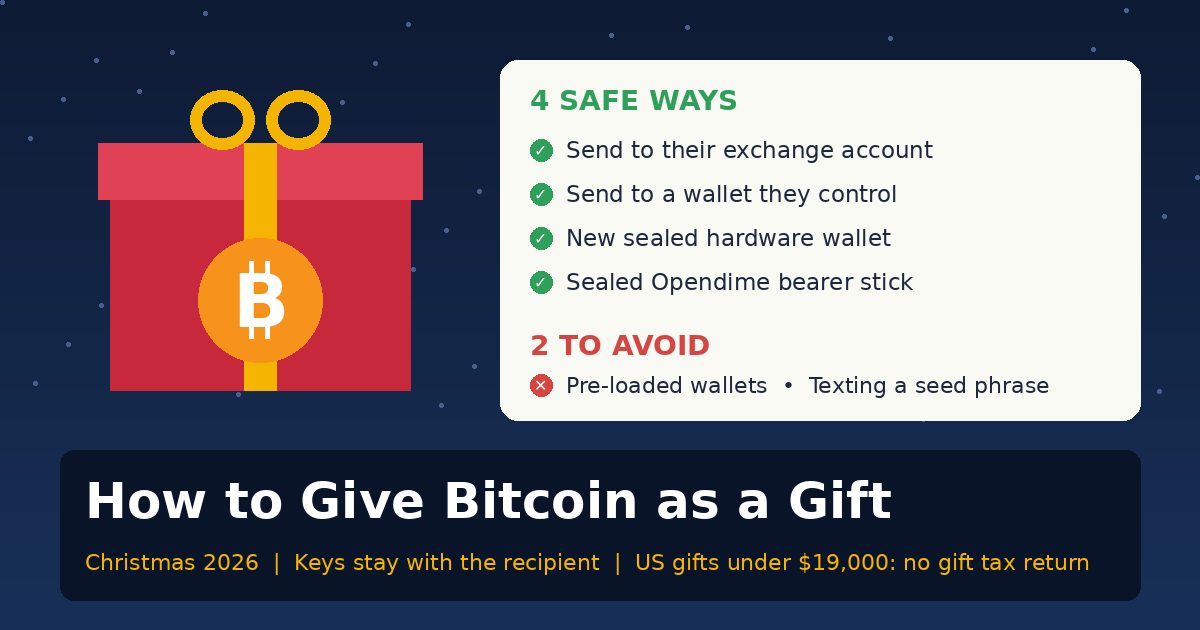
How to give Bitcoin as a gift safely: send it to the person’s own exchange account or wallet, or give a new, sealed hardware wallet or Opendime they set up and check themselves. Never give a pre-loaded wallet or text a seed phrase. In the US, gifts under $19,000 per person need no gift tax return in 2026.
Last updated November 27, 2026. Every number, rule and product detail below links to its source. This article is for education only and is not tax advice or financial advice.
What you are really giving when you give Bitcoin
Owning Bitcoin means controlling the secret keys that can move it, or the recovery phrase that backs them up. A good Bitcoin gift ends with only the recipient, or an exchange account in their name, able to spend it. If anyone else still knows the phrase, the gift is not really theirs.
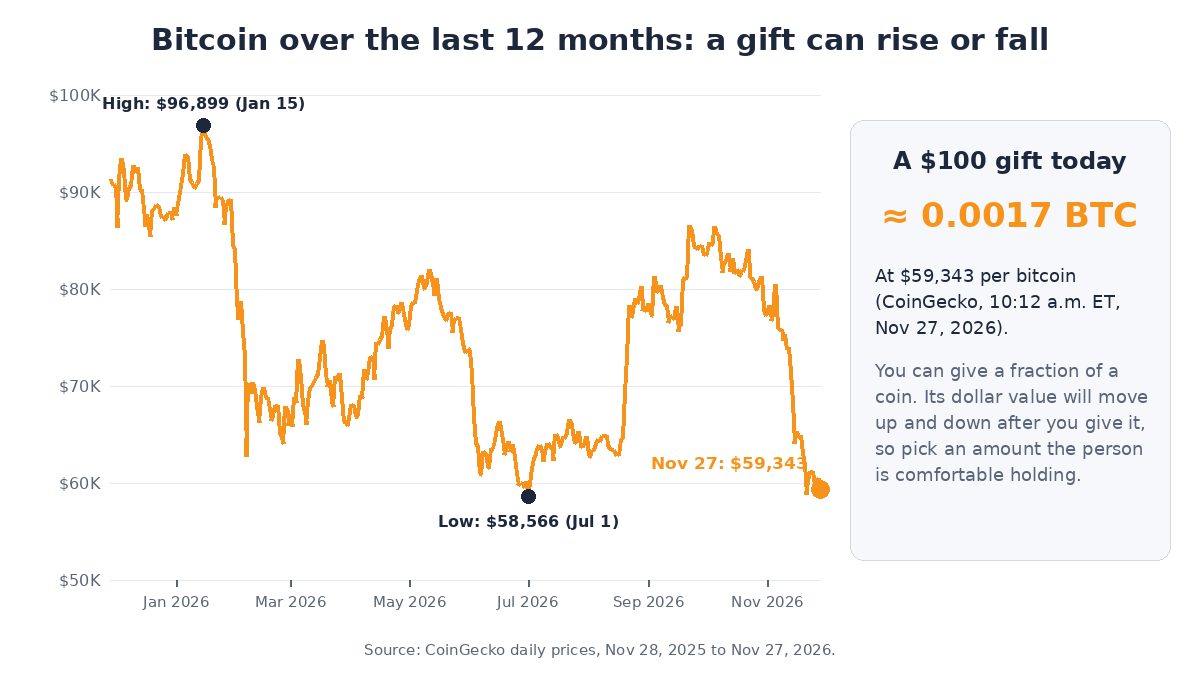
You do not need to give a whole coin. Bitcoin was about $59,343 at 10:12 a.m. ET on November 27, 2026, so a $100 gift buys about 0.0017 BTC (CoinGecko). That is about 53% below the record of $126,080 set on October 6, 2025, so the gift can lose value as well as gain it. Sharp drops happen fast, as our explainer on crypto flash crashes shows, so give an amount the person will not mind seeing swing. If you still need to buy the coins, our beginner guide to buying your first Bitcoin covers the basics.
4 safe ways to give Bitcoin as a gift
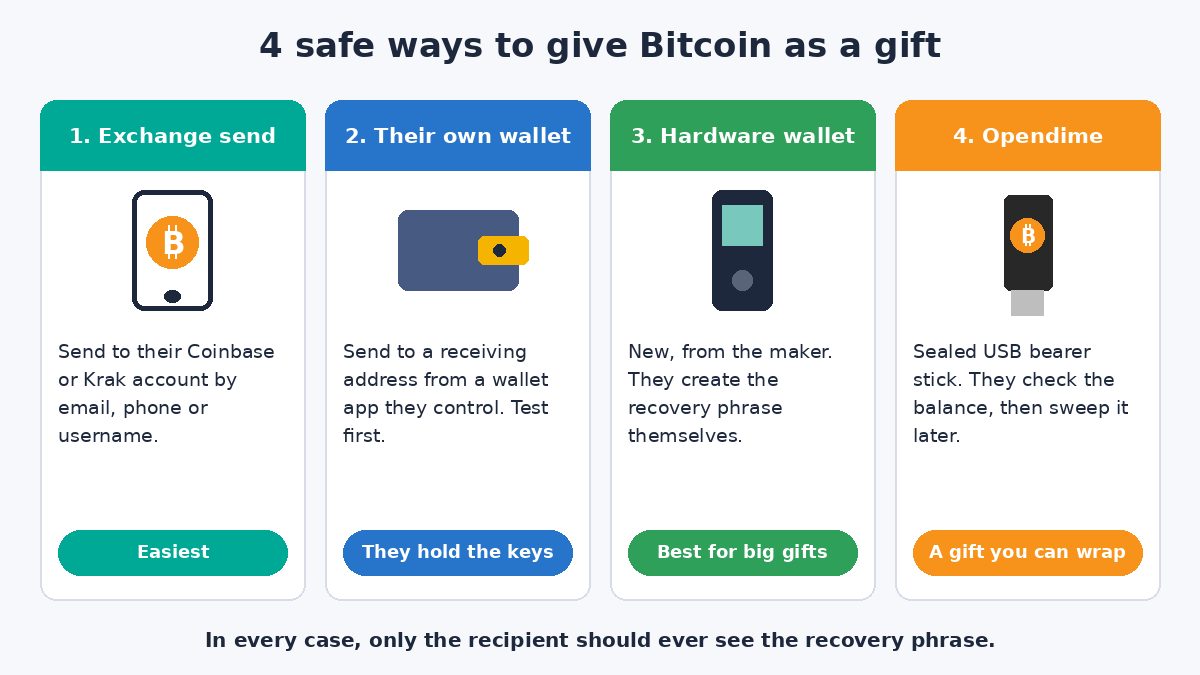
1. Send it to their exchange account (easiest)
Disclosure: Some links in this article are, or may become, affiliate links. If you sign up or buy through them, Cryptolix may earn a commission at no extra cost to you. This never changes what we recommend. See our Affiliate Disclosure. This article is for education only and is not financial advice. As an Amazon Associate, Cryptolix earns from qualifying purchases.
If the person uses an exchange app, or is happy to sign up, this is the simplest gift. On Coinbase, you can send Bitcoin to another user by email address, phone number or username. These internal sends are instant, carry no transaction fee and can include a note (Coinbase Help). If the recipient does not accept within 30 days, the coins come back to you (Coinbase Help). They need a verified account, and Coinbase requires users to be 18 or older (Coinbase Help).
Kraken’s Krak app works the same way between Krak users, by Kraktag, email or phone, with no fee if you already hold the coin you send. A paylink reaches someone without an account but expires after 14 days, and availability varies by location (Krak Support; Krak FAQ). Cash App no longer supports Bitcoin transfers between $cashtags; since December 20, 2024 you need the recipient’s Bitcoin address or Lightning invoice (Cash App).
2. Send it to a wallet they control
If the person already has a Bitcoin wallet app, you can send the coins straight to it, so the keys are theirs from day one:
- Ask them for a Bitcoin receiving address or QR code from their wallet.
- Send a small test amount and have them confirm it arrived. On-chain transfers cannot be reversed if the address is wrong, and they cost a network fee (Coinbase Help).
- Send the rest and keep the transaction record.
Our guide on whether it is safe to keep crypto on an exchange explains why moving coins to a wallet you control removes the exchange’s risk but makes you responsible for the backup.
3. Give a new hardware wallet, sealed, and let them set it up
For a bigger gift, buy a new hardware wallet straight from the maker, such as Ledger or Trezor, and give it unopened. Trezor says to buy only from its official shop, its Amazon storefront or an authorized reseller, and that its devices ship without firmware (Trezor; Trezor). They create their own recovery phrase during setup, then you send Bitcoin to the address their device shows. Wrap it with a readable book such as The Bitcoin Standard if they want to understand what they hold.
4. Hand over a sealed Opendime
An Opendime is a small USB stick made by Coinkite that works like a Bitcoin banknote. You load it, the recipient plugs it in to check its address, balance and seal, and later they break the seal to reveal the private key and move the coins to their own wallet. The key is generated inside the device and is never shown to anyone while it is sealed (Opendime). The current v4 sells in 3-packs listed at $69 on Coinkite’s store (Coinkite). Treat it like cash.
2 Bitcoin gifts to avoid
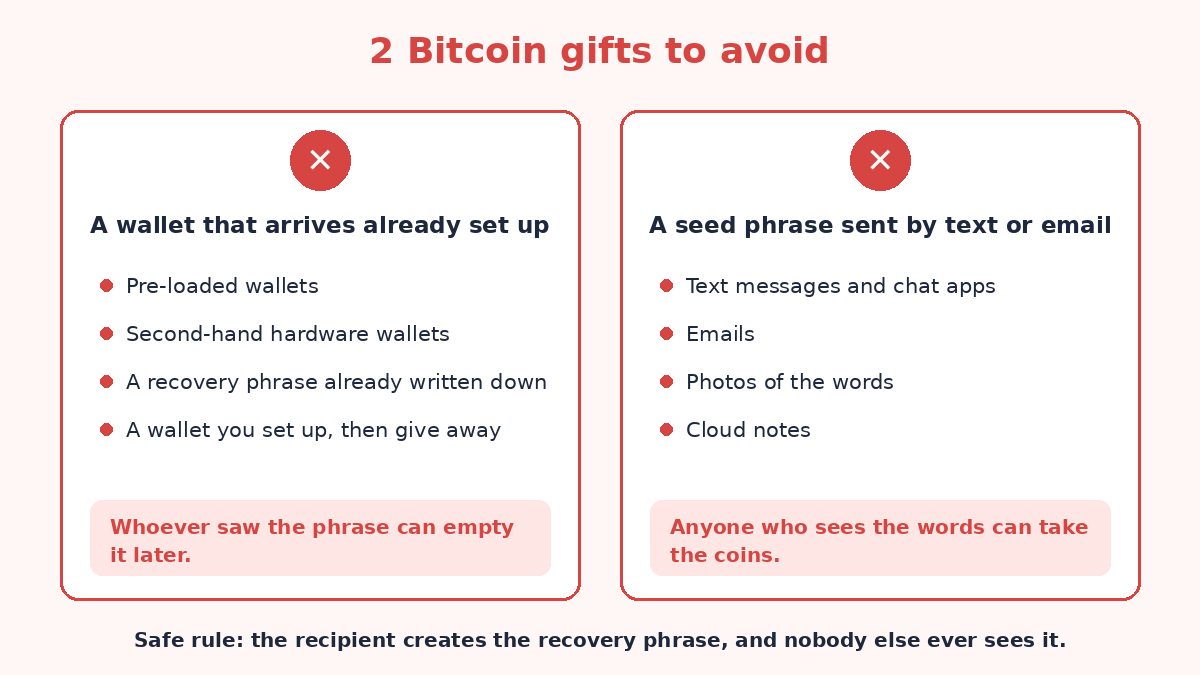
1. A wallet that arrives already set up
Skip pre-loaded wallets, second-hand hardware wallets and anything that comes with a recovery phrase already written down. Ledger has warned about a buyer who lost his coins after buying a second-hand device that the seller had already initialized; its devices never ship with seed words or a PIN (Ledger). Trezor says never to buy from an unauthorized third party, because you cannot know who had access to the device (Trezor). The same goes for a wallet you set up yourself and then give away: you still know the phrase.
2. Sending a recovery phrase or private key by text or email
A recovery phrase is the money itself. Anyone who has it can control the funds (Experian), and Trezor’s rule is simple: never share your wallet backup with anyone (Trezor). Texts, emails and photos get copied, synced and hacked. If a gift requires sending words or keys over a message, pick another method.
Bitcoin gift methods compared
| Method | Best for | What the recipient needs | Main risk | Verdict |
|---|---|---|---|---|
| Exchange send (Coinbase, Krak) | Beginners, small amounts | Verified account on the same app, 18+ | Coins stay with the exchange | Safe, easiest |
| Send to their own wallet | People who already use a wallet | A wallet app and a receiving address | A wrong address cannot be reversed | Safe, test first |
| New sealed hardware wallet | Larger gifts | Time to set it up and store the phrase | Losing the device and the phrase | Safest for big amounts |
| Sealed Opendime | An in-person gift you can wrap | A USB port and a wallet to sweep into later | Lost or damaged stick = lost coins | Safe, treat like cash |
| Pre-loaded or second-hand wallet | Nobody | Trust in whoever set it up | Someone else may have the phrase | Avoid |
| Recovery phrase sent by text or email | Nobody | Nothing, which is the problem | Anyone who sees it can take the coins | Avoid |
Do you pay tax on a Bitcoin gift? (US)
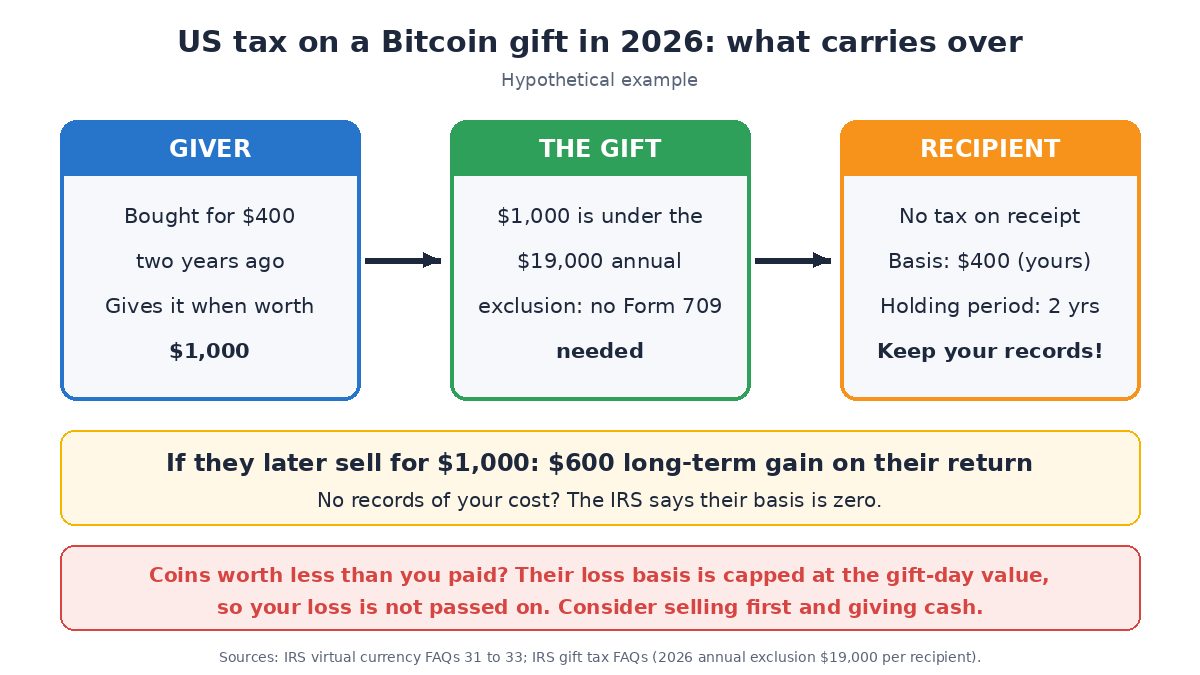
For the giver: in 2026 you can give up to $19,000 per recipient without filing a gift tax return, or $38,000 per recipient for a married couple who split gifts (IRS). Above that, file Form 709, which the IRS lists for gifts of digital assets (IRS). Gift tax is generally paid by the giver, and only once lifetime taxable gifts pass the basic exclusion of $15,000,000 for 2026 (IRS).
For the recipient: a bona fide gift of crypto is not income. They owe tax only when they sell, swap or spend it. For a gain, their cost basis is yours (plus any gift tax paid), and their holding period includes yours, but only if they have records; without them, the basis is zero (IRS FAQs 31 to 33). So put the purchase date and price in the card.
One trap: if your coins are now worth less than you paid, the recipient cannot use your loss, because their basis for a loss is capped at the value on the day of the gift (IRS FAQ 32). It can make more sense to sell first, claim the loss yourself through crypto tax-loss harvesting before December 31, and give the cash or freshly bought Bitcoin instead.
Checklist: before you wrap a Bitcoin gift
- ☐ The person actually wants Bitcoin and will not need the money soon.
- ☐ They know which app or wallet they will use, and they are 18+ for an exchange account.
- ☐ No one but the recipient will ever see the recovery phrase.
- ☐ Any hardware wallet is new, sealed and bought from the maker or an authorized seller.
- ☐ I sent a small test amount before the full gift to a wallet address.
- ☐ I wrote down the purchase date and cost for their tax records.
- ☐ The gift stays under $19,000 per person, or I will file Form 709.
Video: the worst ways to gift crypto
In this two-minute clip from December 2020, Andreas M. Antonopoulos, co-author of Mastering Bitcoin, explains which crypto gifts backfire, such as gifts with strings attached. It predates today’s apps, but the advice holds.
Frequently asked questions
Can I give Bitcoin to a child?
Not straight into their own exchange account: Coinbase, for example, requires account holders to be 18 or older. For a minor, a parent can hold the coins in their own account, or you can give a sealed Opendime or hardware wallet that a parent helps set up.
Do I have to pay tax when I give Bitcoin as a gift?
Usually not. In 2026 you can give up to $19,000 per person with no gift tax return. Above that you file Form 709, but gift tax is only owed after lifetime taxable gifts pass $15 million (2026 figure). The recipient takes over your cost basis.
Does the person who receives Bitcoin as a gift owe tax?
Not when they receive it. The IRS says a bona fide gift is not income. They owe tax only when they sell or spend it, using your original cost and purchase date, so give them those records with the gift.
What happens if they never claim a Bitcoin gift?
On Coinbase, crypto sent to an email address or phone number that is not accepted within 30 days goes back to you. A Krak paylink expires after 14 days. A sealed Opendime or hardware wallet does not expire, but it can be lost.
What is the safest way to give Bitcoin as a gift?
For a beginner, sending it to their own account on a regulated exchange is simplest. For larger amounts, a new hardware wallet bought from the maker, which they set up themselves, is safest. Never hand over a wallet whose recovery phrase someone else has seen.
This article is for education only and is not tax advice or financial advice. App features and tax limits change, so check them before you send. More guides in our Crypto Currency section.
Sources
- CoinGecko: Bitcoin price, Nov 27, 2026 (10:12 a.m. ET)
- Coinbase Help: Steps to send crypto
- Coinbase Help: Pending crypto transactions (30-day return)
- Coinbase Help: Create a Coinbase account (18 or older)
- Krak Support: How to send cash or crypto with Krak (July 3, 2026)
- Krak Support: Krak FAQ (Oct 26, 2026)
- Cash App Help: Sending and receiving bitcoin
- Trezor: Where to buy a genuine Trezor hardware wallet
- Trezor: Is my device safe to use?
- Trezor: Scams and phishing
- Ledger: Scam warning on second-hand Ledger devices
- Opendime (Coinkite): How it works
- Coinkite store: Opendime v4 3-pack
- Experian: How to give cryptocurrency as a gift (July 23, 2026)
- IRS: Frequently asked questions on gift taxes (updated July 2026)
- IRS: What’s new, estate and gift tax (updated Nov 3, 2026)
- IRS: Digital assets (updated Sept 2, 2026)
- IRS: Frequently asked questions on virtual currency transactions (FAQs 31 to 33)