
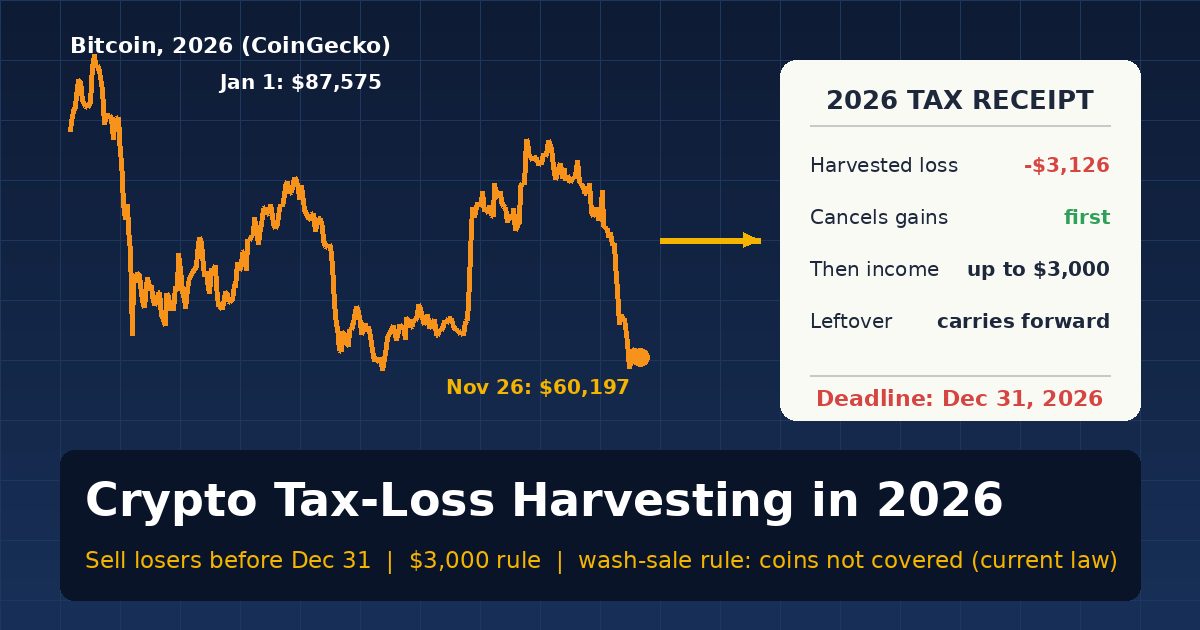
Crypto tax-loss harvesting means selling coins worth less than you paid, before December 31, so the loss cuts your 2026 tax bill. Losses cancel capital gains, then up to $3,000 of ordinary income, and the rest carries forward. Under current law the wash-sale rule does not cover coins you hold directly, so you can buy back right away.
Last updated November 26, 2026. Every number and date below links to its source. This article is for education only and is not tax advice or financial advice; check your own situation with a tax professional.
What is crypto tax-loss harvesting?
The IRS treats crypto as property, not currency (IRS). Selling, swapping one coin for another, or spending crypto creates a gain or a loss. A loss only counts once you sell: a coin that has crashed but still trades is not a deductible loss while you hold it (IRS Chief Counsel memo 202302011).
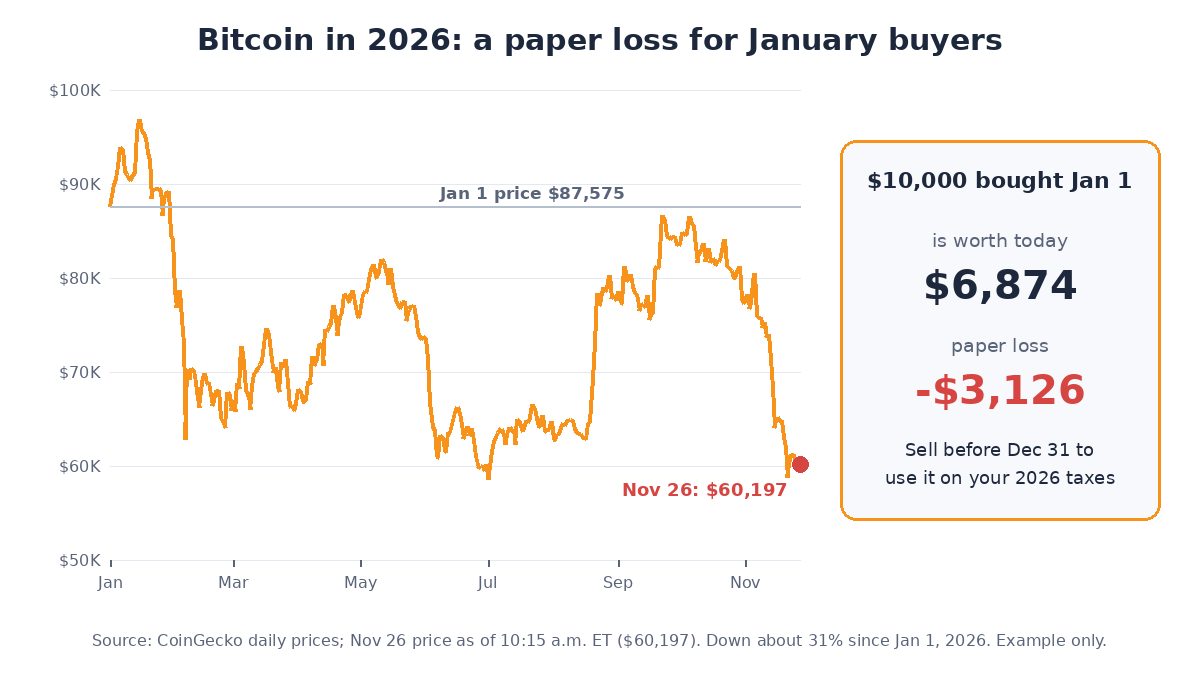
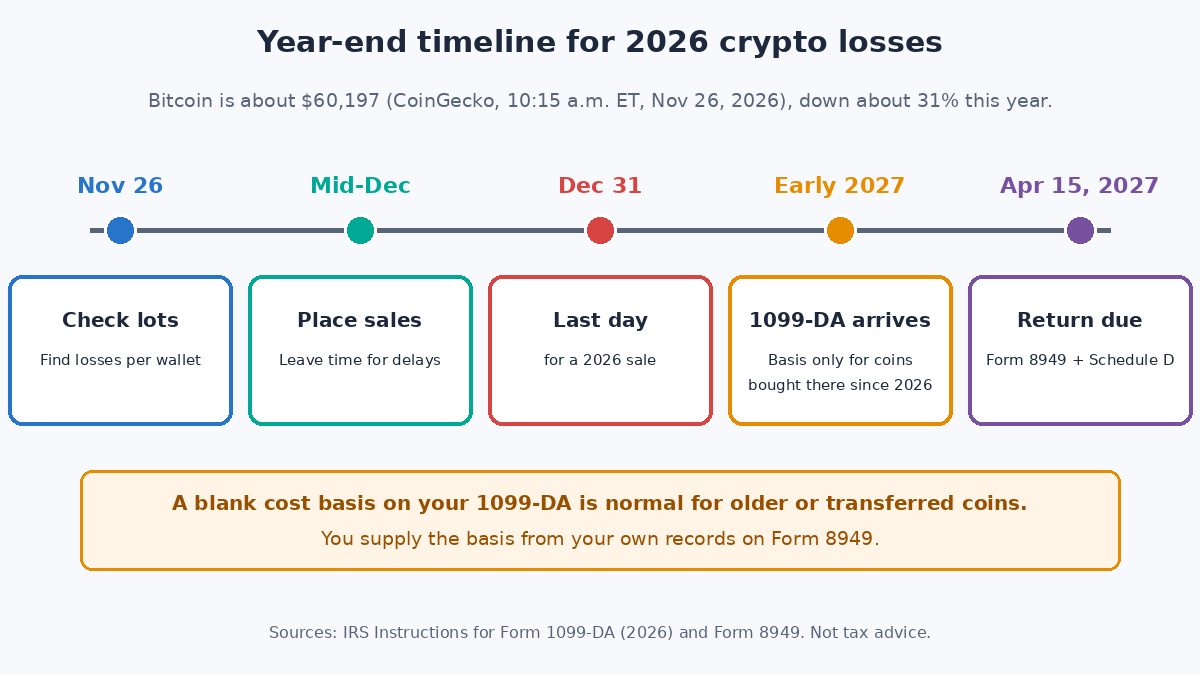
This year, plenty of people have losses to harvest. Bitcoin was about $87,575 on January 1 and about $60,200 at 10:15 a.m. ET on November 26, 2026, down roughly 31% (CoinGecko). Someone who put $10,000 in on New Year’s Day holds about $6,874 today. Selling turns that $3,126 paper loss into a real one you can use on your taxes. If a stop-loss already sold your coins during a crash, like the one in our explainer on the Kraken flash crash, that loss is already realized.
Does the wash-sale rule apply to crypto in 2026?
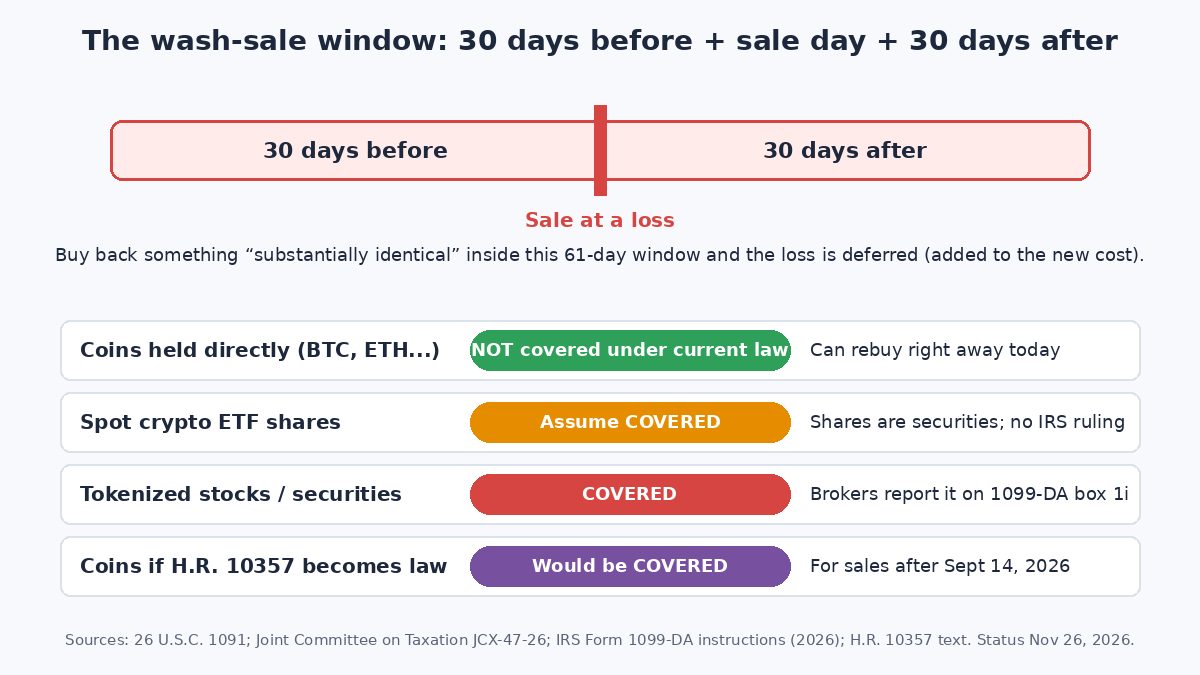
For stocks, the wash-sale rule blocks a loss if you buy the same or a “substantially identical” security within 30 days before or after the sale (26 U.S.C. 1091). The disallowed loss is not lost forever; it is added to the cost of the new shares.
Coins you hold directly: not covered today
Congress’s own tax staff wrote in September 2026 that digital assets “are not expressly within the scope of section 1091,” and that the IRS has issued no guidance applying it to them (Joint Committee on Taxation). A Congressional Research Service brief from November 20 says the same (CRS). So today you can sell Bitcoin at a loss and buy it back minutes later (Fidelity Digital Assets).
Crypto ETFs and tokenized stocks: treat them as covered
Spot Bitcoin ETF shares trade like stock. Buying the same ETF back within 30 days triggers the rule, and there is no IRS ruling on whether two companies’ funds tracking the same asset count as identical (Fidelity). Tokenized securities are clearly covered: the IRS has brokers report their wash-sale losses on Form 1099-DA (IRS). Our guide on how tokenized stocks work in the US explains why they count as securities.
The bill that could change it
H.R. 10357, the Digital Asset Tax Certainty Act, would extend the rule to “any traded digital asset” except qualified dollar stablecoins. It cleared the House Ways and Means Committee 38 to 5 on September 16, 2026, and has not passed the House or Senate (Congress.gov). The catch: as written, it applies to sales after September 14, 2026, which could reach this year’s harvesting (bill text; RSM). On November 20, a cosponsor said he wants a House vote before this Congress ends, without a date (The Block). The Senate’s ADAPT Act, S. 5616, would apply only to sales after it becomes law (bill text).
| What you hold | Wash-sale rule today | If H.R. 10357 became law as written |
|---|---|---|
| Bitcoin, ether or other coins held directly (exchange or wallet) | Not covered under current law; no IRS guidance applies it | Covered for sales after Sept 14, 2026 |
| Dollar stablecoins such as USDC | Not covered | Qualified dollar stablecoins excluded |
| Spot crypto ETF shares (for example, IBIT) | Safest to assume covered; shares are securities | Covered |
| Tokenized stocks and other tokenized securities | Covered; brokers report disallowed losses (box 1i) | Covered, and treated as substantially identical to the matching stock |
How much can a crypto loss save you?
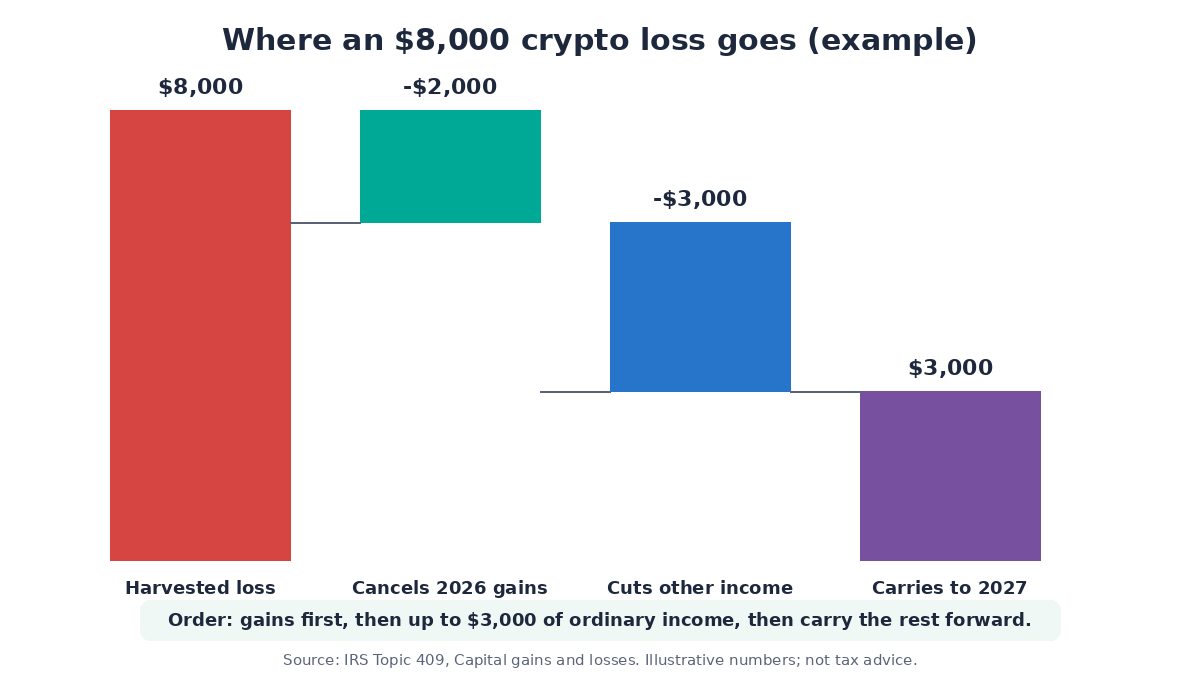
Losses first offset capital gains of any size. If losses are left over, you can deduct up to $3,000 from wages and other income ($1,500 if married filing separately), and carry the rest forward to later years (IRS Topic 409).
Timing matters too. Coins held one year or less produce short-term gains, taxed like wages at rates up to 37% in 2026. Coins held longer get long-term rates of 0%, 15% or 20%; the 0% rate covers taxable income up to $49,450 for single filers and $98,900 for married couples filing jointly (IRS Rev. Proc. 2025-32). A harvested loss is most valuable against short-term gains.
How to harvest crypto losses before Dec 31: 7 steps
- Pull your full history. Export trades from every exchange and wallet you used, including old accounts and swaps.
- Find losses wallet by wallet. Since January 1, 2025, cost basis is tracked per account or wallet, so a loss on one exchange cannot borrow the price you paid on another (Fidelity Digital Assets). Our guide on keeping crypto on an exchange covers why fewer accounts also means less risk.
- Pick your highest-cost lots. Without instructions, the IRS treats your oldest coins at that exchange as sold first. Through December 31, 2026, the IRS lets you name the units in your own records before the sale (IRS Notice 2026-20).
- Compare the loss with your gains. Harvest enough to cancel this year’s gains plus $3,000. Bigger losses still carry forward, but they help more slowly.
- Sell early, not on New Year’s Eve. For crypto ETF shares, the trade date counts, not the settlement date (IRS Pub. 550). For coins, aim to finish by mid-December in case an exchange is slow.
- Decide whether to buy back now or wait 31 days. Rebuying coins right away is allowed today. Waiting 31 days, and not buying the same coin in the 30 days before the sale, protects you if H.R. 10357 passes with its September 14 date. Never rebuy the same ETF inside 30 days.
- Save proof. Keep trade confirmations, the lots you chose, and fees paid. You will need them when the forms arrive.
Remember that harvesting works only in a regular taxable account. Trades inside a 401(k) or IRA do not create deductible losses; see our guide on putting crypto in a 401(k) or IRA. And a new purchase restarts your holding clock, so the bought-back coins need another year to qualify for long-term rates.
Disclosure: Some links in this article are, or may become, affiliate links. If you sign up or buy through them, Cryptolix may earn a commission at no extra cost to you. This never changes what we recommend. See our Affiliate Disclosure. This article is for education only and is not financial advice.
Crypto tax software can do the math for you. Koinly has a Tax Optimization dashboard that flags coins sitting at a loss and previews the tax effect of a sale before you make it (Koinly Help). CoinLedger builds a Tax Loss Harvesting report for the current calendar year (CoinLedger Help). Both import exchange history and produce Form 8949, but neither replaces a tax professional.
Reporting your losses: Form 8949, Schedule D and the new 1099-DA
Every sale goes on Form 8949, which now has separate boxes for short-term and long-term digital asset sales, and the totals flow to Schedule D (IRS). Your 2026 return is due April 15, 2027.
For 2026, US brokers must report gross proceeds for all crypto sales on Form 1099-DA, but cost basis only for “covered” coins: those bought on that platform after 2025 and kept there until sold. Coins bought earlier or transferred in may show no basis (IRS). If the basis box is blank, you supply the basis from your own records on Form 8949. Our crypto trading tips for beginners include simple record-keeping habits.
Checklist: before you harvest a crypto loss
- ☐ I know my total 2026 gains and losses so far.
- ☐ I checked losses per wallet or exchange, not as one pool.
- ☐ I chose and recorded which lots to sell before selling.
- ☐ I am not rebuying the same ETF or tokenized stock within 30 days.
- ☐ I decided whether to wait 31 days in case H.R. 10357 passes.
- ☐ My sales will be done well before December 31.
- ☐ I saved confirmations and will check my 1099-DA against my records.
Video: how crypto is taxed in 2026
This Fidelity Investments session from February 2026 covers the basics, the new Form 1099-DA, and tax-loss harvesting with specific lots (from 28:46). It predates H.R. 10357, so use the article above for the bill’s status.
Frequently asked questions
Does the wash-sale rule apply to crypto in 2026?
Not to coins you hold directly, under current law. The rule covers stock and securities, and the IRS has issued no guidance applying it to crypto. Crypto ETF shares and tokenized securities are different: treat them as covered. H.R. 10357 would extend the rule but is not law.
How much crypto loss can I deduct?
Losses first cancel out capital gains, with no cap. If losses are left over, you can deduct up to $3,000 a year from other income ($1,500 if married filing separately) and carry the rest into future years.
What is the deadline for crypto tax-loss harvesting?
The sale must happen in 2026, so by December 31. Do not wait for the last day: exchanges get busy and wallet transfers take time. A loss you take in January 2027 counts on your 2027 return instead.
Can I sell crypto at a loss and buy it back right away?
Under current law, yes, for coins you hold directly. But H.R. 10357, if passed as written, would apply wash-sale rules to sales after September 14, 2026. Waiting 31 days before rebuying removes that risk, at the cost of being out of the market.
Do I need a Form 1099-DA to report crypto losses?
No. You report every sale on Form 8949 and Schedule D, with or without a broker form. For 2026, brokers report proceeds for all sales but cost basis only for coins bought on their platform since January 1, 2026.
This article is for education only and is not tax advice or financial advice. Tax rules can change, and the wash-sale bill could pass after publication. More guides in our Crypto Currency section.
Sources
- CoinGecko: Bitcoin price data, Nov 26, 2026
- IRS: Digital assets (updated Sept 2, 2026)
- IRS Chief Counsel Advice 202302011: crypto that has declined in value
- 26 U.S.C. 1091: Loss from wash sales of stock or securities (Cornell LII)
- Joint Committee on Taxation: Description of H.R. 10357, JCX-47-26 (Sept 14, 2026)
- Congressional Research Service: Income Tax Treatment of Cryptocurrency, IF13359 (Nov 20, 2026)
- Fidelity Digital Assets: 2026 Year-End Crypto Tax Considerations (Nov 17, 2026)
- Fidelity: Tax rules for ETF losses
- IRS: Instructions for Form 1099-DA (2026)
- Congress.gov: H.R. 10357, Digital Asset Tax Certainty Act (all actions)
- GovInfo: H.R. 10357 text, sec. 301
- RSM: Senate ADAPT Act (Oct 30, 2026)
- The Block: Rep. Horsford sees opening for House vote on crypto tax bill (Nov 20, 2026)
- GovInfo: S. 5616, ADAPT Act, sec. 7
- IRS Topic 409: Capital gains and losses
- IRS Revenue Procedure 2025-32: 2026 inflation adjustments
- IRS Notice 2026-20: Extension of temporary relief for identifying digital asset units
- IRS Publication 550: Investment Income and Expenses
- IRS: Instructions for Form 8949
- Koinly Help: Tax Optimization dashboard
- CoinLedger Help: What is tax loss harvesting?