
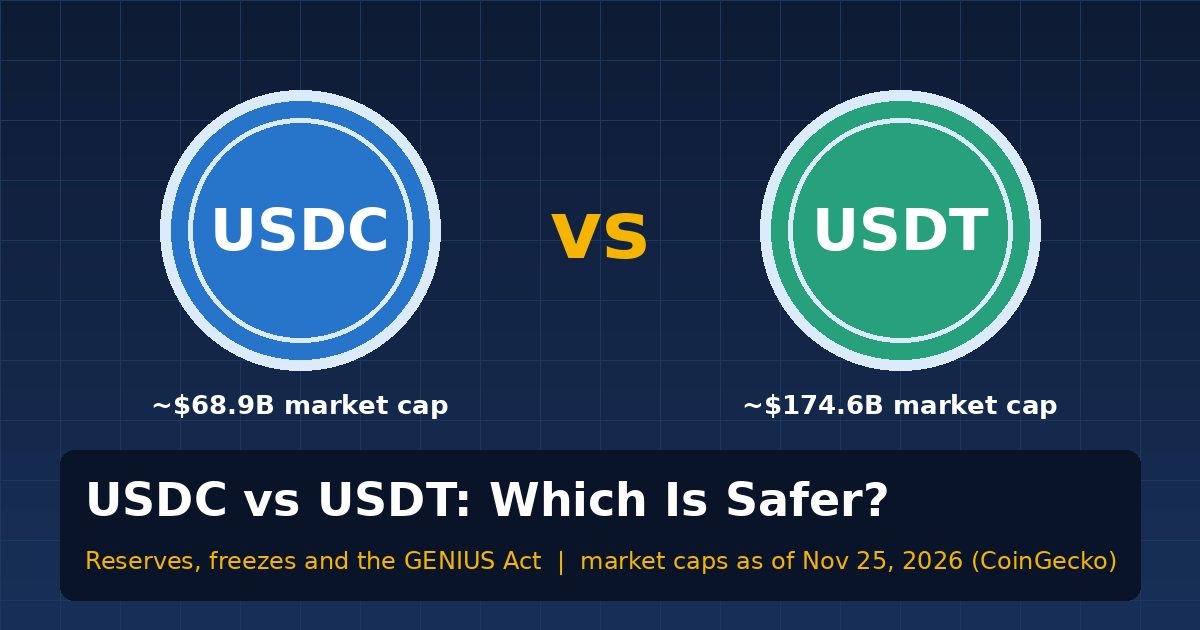
USDC vs USDT: which is safer? For most US beginners, USDC is the safer stablecoin to hold. Its issuer, Circle, is a US public company that publishes reserves weekly and gets monthly Big Four checks. USDT is bigger and easier to trade worldwide, but Tether reports quarterly and does not serve US customers directly. Both can freeze wallets.
Last updated November 25, 2026. Every number and date below links to its source. This article is for education only and is not financial advice.
USDC vs USDT at a glance
Both coins aim to stay worth exactly $1, and both are backed by reserves their issuer holds. The differences are who stands behind each coin, how it proves the money is there, and which rules it follows.
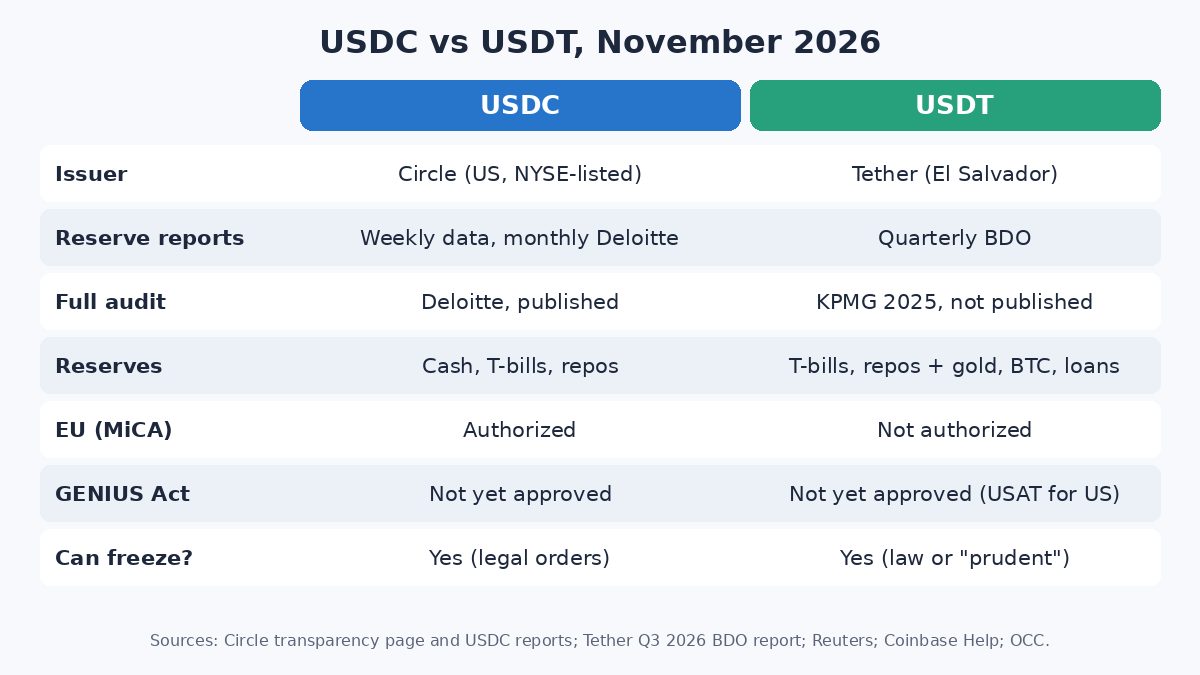
| USDC | USDT | |
|---|---|---|
| Issuer | Circle, a US company listed on the New York Stock Exchange since June 5, 2025 (Circle) | Tether International, based in El Salvador and licensed there as a stablecoin issuer (BDO report) |
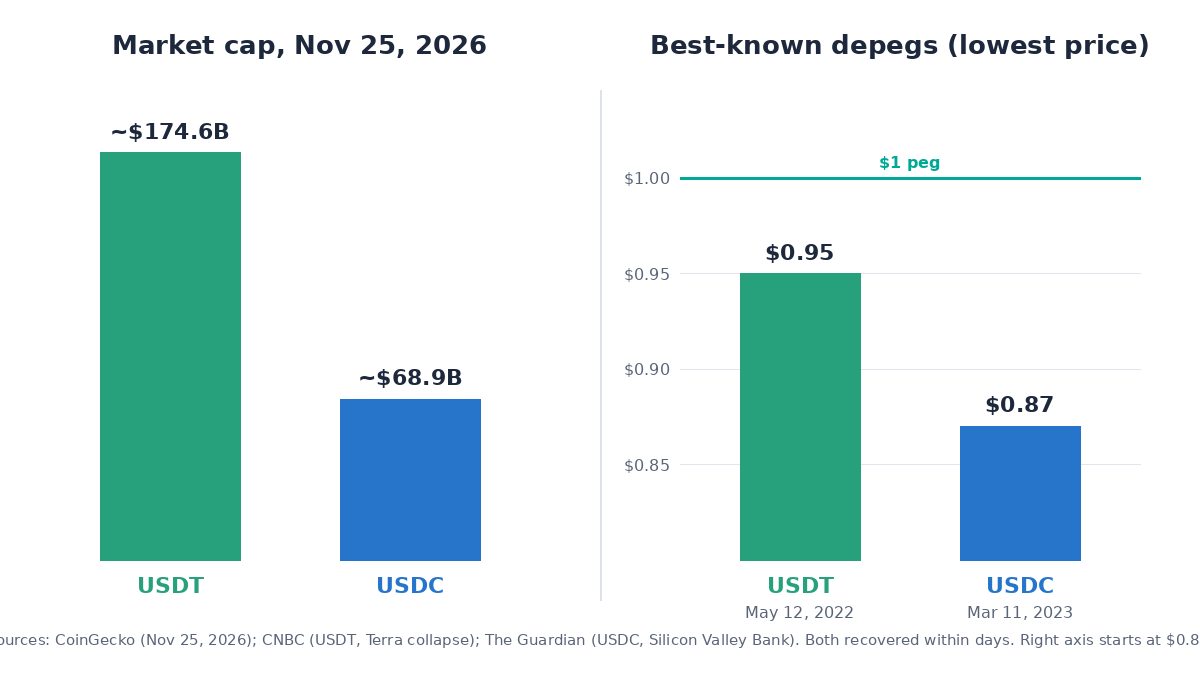
| Market cap (as of Nov 25, 2026) | About $68.9 billion (CoinGecko) | About $174.6 billion (CoinGecko) |
| Reserves | Cash at banks plus a BlackRock-managed government money market fund holding short-term Treasuries and overnight repos | Mostly Treasury bills and repos, plus gold, bitcoin, secured loans and other investments |
| Reserve reports | Holdings published weekly; monthly Deloitte examination (Circle) | Quarterly BDO attestation (Tether) |
| Full audit | Circle’s financial statements are audited by Deloitte (Circle) | KPMG US audited Tether’s 2025 statements; the audit was not made public (Reuters) |
| Regulation | Authorized in the EU under MiCA (Circle); OCC national trust bank charter approved in July 2026 | Not MiCA-authorized; Coinbase converted EEA users’ USDT on Oct 30, 2026 (Coinbase) |
| GENIUS Act status | Not yet approved as a permitted issuer (no one is yet) | Not yet approved; Tether launched a separate US coin, USAT |
| Can freeze addresses? | Yes, mainly under legal orders | Yes, when law requires or when Tether deems it prudent |
| Blockchains | 39 approved blockchains (Deloitte report) | 13 blockchains (BDO report) |
| US availability | Sold by major US exchanges such as Coinbase and Kraken | Traded on US exchanges, but Tether does not issue or redeem for US persons (Tether) |
| Best-known depeg | About $0.87 on March 11, 2023 (Silicon Valley Bank) | About $0.95 on May 12, 2022 (TerraUSD collapse) |
What backs each coin?
USDC reserves
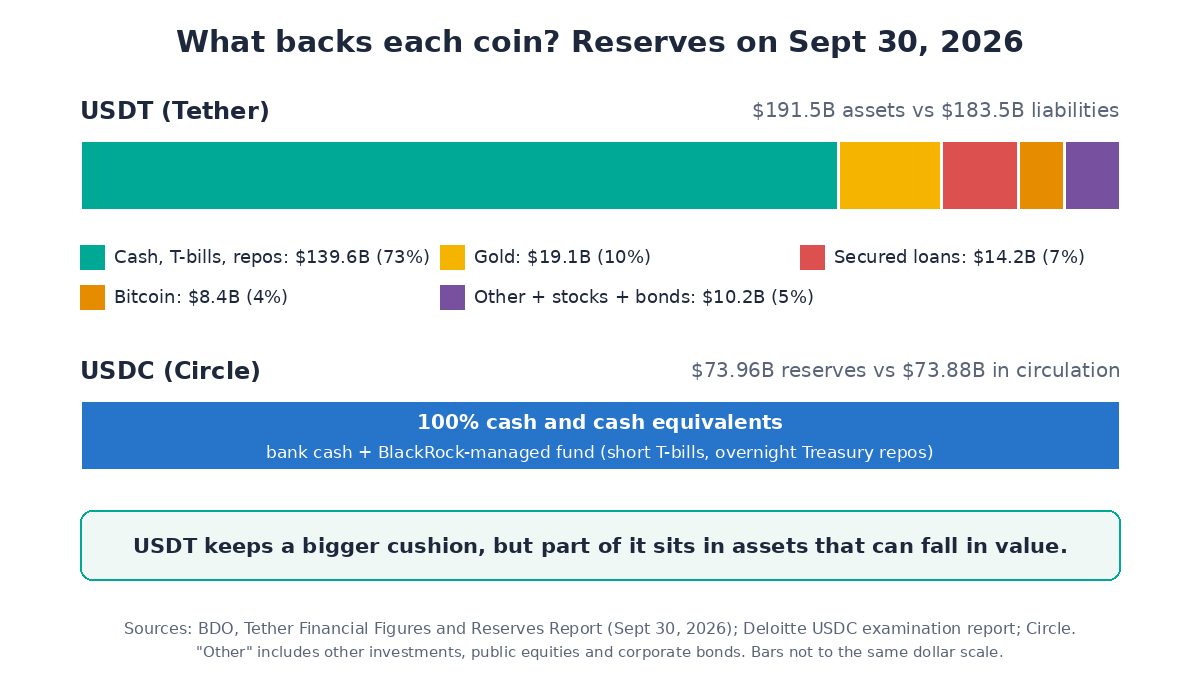
Circle says USDC is backed 100% by cash and cash equivalents. Most of the reserve sits in the Circle Reserve Fund, an SEC-registered government money market fund managed by BlackRock that holds short-dated Treasuries and overnight Treasury repurchase agreements. The rest is cash, mostly at very large banks (Circle). Deloitte’s latest examination found $73.96 billion of reserves against $73.88 billion of USDC in circulation on September 30, 2026 (Deloitte).
USDT reserves
Tether’s third-quarter report, checked by BDO, shows $191.45 billion of assets against $183.50 billion of liabilities on September 30, 2026, a cushion of $7.95 billion (Tether). About $139.6 billion, or 73%, was cash, Treasury bills and repos. The rest included $19.1 billion of gold, $14.2 billion of secured loans, $8.4 billion of bitcoin, and other investments and stocks (BDO report). Gold and bitcoin can fall in value; the cushion is meant to absorb that.
Audits vs attestations: who checks the numbers?
An attestation is an accountant’s check that reserves cover the coins on one specific date. An audit reviews a company’s full-year financial statements. Circle gets a Deloitte attestation every month, and as a listed company it also publishes audited financial statements (Circle).
Tether publishes a BDO attestation every quarter. On August 13, 2026, it said KPMG US gave an unqualified opinion on its 2025 financial statements and that reserves exceeded liabilities by $6.814 billion (Tether). KPMG confirmed the opinion, but the audited statements themselves were not released (Reuters).
Can Tether freeze your funds? Yes, and so can Circle
Both coins have a built-in blacklist. Tether’s terms let it freeze tokens “as required by applicable Law” or where it “determines it is prudent to do so” (Tether terms). Circle’s policy says it blocks addresses to comply with a law or legal order from US or French authorities, for certain urgent law enforcement or sanctions requests, or to protect the network (Circle policy). On September 30, about 131 million USDC sat in blocked addresses (Deloitte).
The Binance theft put both to the test
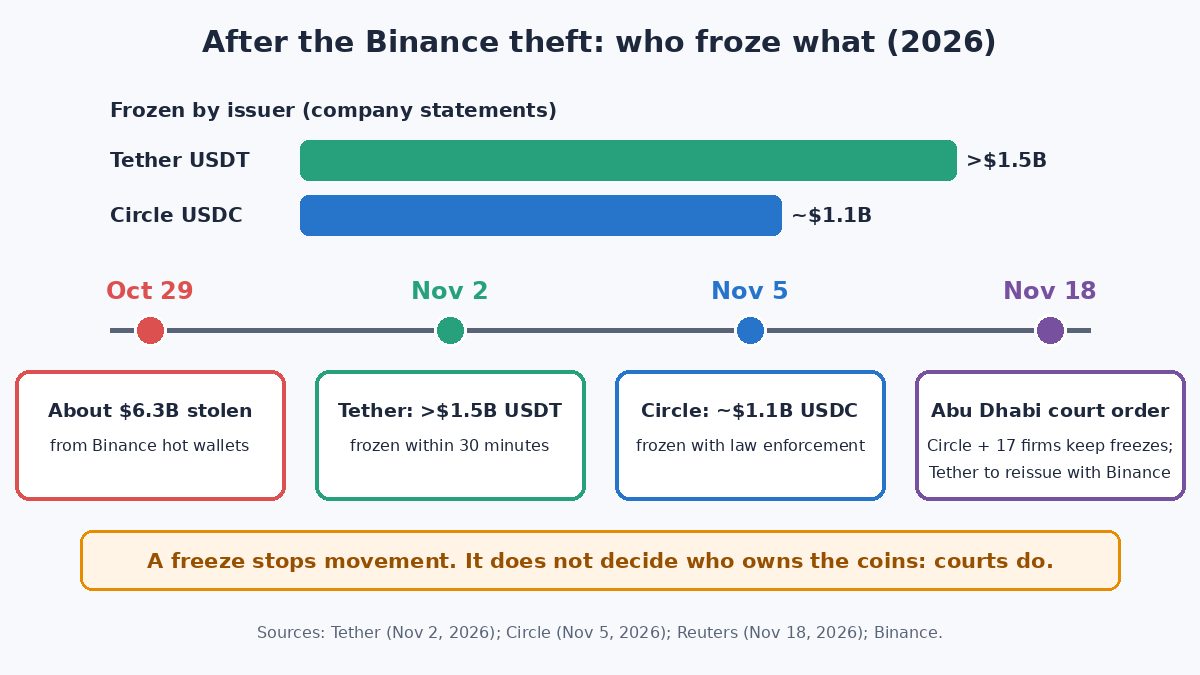
- October 29, 2026: attackers took about $6.3 billion from Binance’s hot wallets. Our guide on whether it is safe to keep crypto on an exchange covers what that theft taught customers.
- November 2: Tether said it froze more than $1.5 billion in USDT within 30 minutes of the attack (Tether).
- November 5: Circle said it froze about $1.1 billion in USDC in coordination with law enforcement, and that it does not decide who owns frozen assets; courts do (Circle).
- November 18: an Abu Dhabi court ordered Circle and 17 other firms to keep tokens frozen. Tether was not named and said it would “work directly with Binance in respect of reissuing the tokens” (Reuters).
- November 24: Bloomberg reported that Tether asked some hack victims for up to 20% of their frozen USDT before reissuing it. That is double the 10% cap in Tether’s published recovery policy, which covers mistaken transfers, not theft. Tether said the fees pay for legal and recovery costs and that it has reissued about $1.2 billion in USDT so far (Bitcoin.com News).
The lesson cuts both ways. A freeze can stop thieves, but the same switch could lock your wallet by mistake or under a court order. Holding either coin means trusting a company, not just code.
Has either coin lost its $1 peg?
- USDT, May 12, 2022: after the TerraUSD collapse, USDT sank to as low as 95 cents on some exchanges, then traded at $0.998 that afternoon. Tether said it was on track to process more than $2 billion of redemptions that day (CNBC).
- USDC, March 11, 2023: USDC fell as low as $0.87 after Circle said $3.3 billion of its roughly $40 billion in reserves was stuck at the failed Silicon Valley Bank (The Guardian). It recovered once US authorities guaranteed the bank’s deposits (Circle).
- Local glitches: on November 21, 2026, USDT briefly traded at 56 Canadian cents on Kraken’s thin Canadian-dollar market. That was one order book, not a real depeg; see our explainer on the Kraken crypto flash crash.
USDC vs USDT under the GENIUS Act
The GENIUS Act, the US stablecoin law signed July 18, 2025, takes effect January 18, 2027 (OCC). From July 18, 2028, US platforms may offer only stablecoins from permitted issuers or from approved foreign regimes (Public Law 119-27, sec. 3). As of today, the OCC is not yet accepting issuer applications, so no coin is approved (OCC). Our plain-English guide to the GENIUS Act explains the rules.
- USDC: Circle received final OCC approval for a national trust bank, Circle National Trust, on July 10, 2026 (Circle). That is a bank charter, not GENIUS Act issuer approval.
- USDT: for Americans, Tether launched USAT on January 27, 2026, issued by Anchorage Digital Bank, N.A., and says USDT is “progressing towards GENIUS Act compliance” (Tether). USAT is still small, about $189 million as of Nov 25, 2026 (CoinGecko).
- Your own wallet: the platform rules do not apply to person-to-person transfers or to wallets you control yourself (sec. 3(h)).
Which should you hold? 5 steps
- Match the coin to the job. For parking dollars on US apps, USDC is the simpler choice. If you trade on overseas exchanges or receive payments on the Tron network, USDT is more common.
- Do not treat either as a bank account. Stablecoins are not FDIC-insured, and the GENIUS Act makes it illegal to market them as federally insured (sec. 4(e)).
- Split large balances. Holding some of each, or keeping only what you need, limits the damage if one issuer has trouble.
- Check the network before you send. An exchange may accept USDC on Ethereum but not on Solana, and sending on a network the receiver does not support can lose your coins.
- Know the alternatives. Tokenized Treasury funds can pay interest, but they are typically securities, not stablecoins. Our guide to real-world asset tokenization explains the difference.
Disclosure: Some links in this article are, or may become, affiliate links. If you sign up or buy through them, Cryptolix may earn a commission at no extra cost to you. This never changes what we recommend. See our Affiliate Disclosure. This article is for education only and is not financial advice.
You can buy USDC with dollars on Coinbase or Kraken, two large US exchanges. For savings you will not touch for months, a hardware wallet such as Ledger or Trezor keeps the coins off the exchange. Both support Ethereum tokens such as USDC and USDT.
Checklist: before you hold a stablecoin
- ☐ I know who issues my coin and where its latest reserve report is.
- ☐ I checked the report date: monthly for USDC, quarterly for USDT.
- ☐ I understand the issuer can freeze addresses.
- ☐ I am not counting on FDIC insurance.
- ☐ I know which blockchain network I am using and double-checked the address.
- ☐ Large or long-term balances are in a wallet I control.
- ☐ I will recheck GENIUS Act news before July 18, 2028.
Video: how stablecoins work
This CNBC International explainer from June 2022 shows how reserve-backed stablecoins work and why TerraUSD failed. It predates the USDC depeg and the GENIUS Act, so use the article above for current facts.
Frequently asked questions
Is USDC safer than USDT?
For US beginners, USDC is usually the safer pick on transparency and regulation: weekly reserve data, monthly Deloitte checks and EU authorization. USDT is bigger and easier to trade, with a $7.95 billion reserve cushion, but it holds riskier assets and reports quarterly.
Can Tether freeze my USDT?
Yes. Tether’s terms let it freeze tokens when the law requires it or when it decides freezing is prudent. After the October 29, 2026 Binance theft, it froze more than $1.5 billion in USDT. Circle can freeze USDC addresses too, mainly under legal orders.
What is the difference between USDC and USDT?
USDC is issued by Circle, a US public company, and backed by cash and short-term Treasuries. USDT is issued by El Salvador-based Tether, is about 2.5 times larger, and its reserves also include gold, bitcoin and secured loans.
Is USDC safe to hold on Coinbase?
USDC on Coinbase carries two risks: Circle’s and Coinbase’s. USDC is not FDIC-insured. For large or long-term amounts, a hardware wallet you control removes the exchange risk, although Circle can still freeze an address under a legal order.
Will the GENIUS Act change which stablecoin I should use?
Possibly. From July 18, 2028, US platforms may offer only stablecoins from approved issuers or approved foreign regimes, and no coin is approved yet. Stablecoins held in your own wallet are outside those platform rules.
This article is for education only and is not financial advice. Stablecoins can lose their peg, and issuers can freeze addresses. More guides in our Crypto Currency section.
Sources
- CoinGecko: Tether (USDT) market data, Nov 25, 2026
- CoinGecko: USDC market data, Nov 25, 2026
- CoinGecko: USAT market data, Nov 25, 2026
- Circle: Transparency & Stability
- Deloitte: USDC examination report for Sept 4 and Sept 30, 2026 (dated Oct 26, 2026)
- Circle: Stablecoin Access Denial Policy
- Circle: The Binance Incident: Collective Defense Must Move at Machine Speed (Nov 5, 2026)
- Circle: Circle announces pricing of upsized initial public offering (June 2025)
- Circle: Circle receives final OCC approval to establish national trust bank (July 10, 2026)
- Circle: MiCA USDC white paper (Circle Internet Financial Europe SAS)
- Circle: $3.3 billion of USDC reserve risk removed, dollar de-peg closes (March 2023)
- Tether: Transparency
- Tether: Q3 2026 attestation press release (Oct 30, 2026)
- BDO: Tether International Financial Figures and Reserves Report as of Sept 30, 2026
- Tether: Tether completes the largest inaugural financial audit in history (Aug 13, 2026)
- Reuters: Stablecoin issuer Tether says KPMG US has audited its 2025 statements (Aug 14, 2026)
- Tether: Tether freezes over $1.5 billion from Binance hack (Nov 2, 2026)
- Tether: Terms of Service
- Tether: U.S. Residents
- Tether: Launch of USA₮ (Jan 27, 2026)
- Reuters via CNA: UAE court orders freeze on crypto tokens stolen from Binance wallets (Nov 18, 2026)
- Coinbase Help: MiCA non-compliant stablecoins
- The Guardian: USD Coin value falls after revealing $3.3bn held at Silicon Valley Bank (March 11, 2023)
- CNBC: The world’s biggest stablecoin has dropped below its $1 peg (May 12, 2022)
- GovInfo: Public Law 119-27, the GENIUS Act
- OCC Bulletin 2026-50: GENIUS Act regulations, final rule (Oct 21, 2026)
- OCC: GENIUS Act page (applications status)