
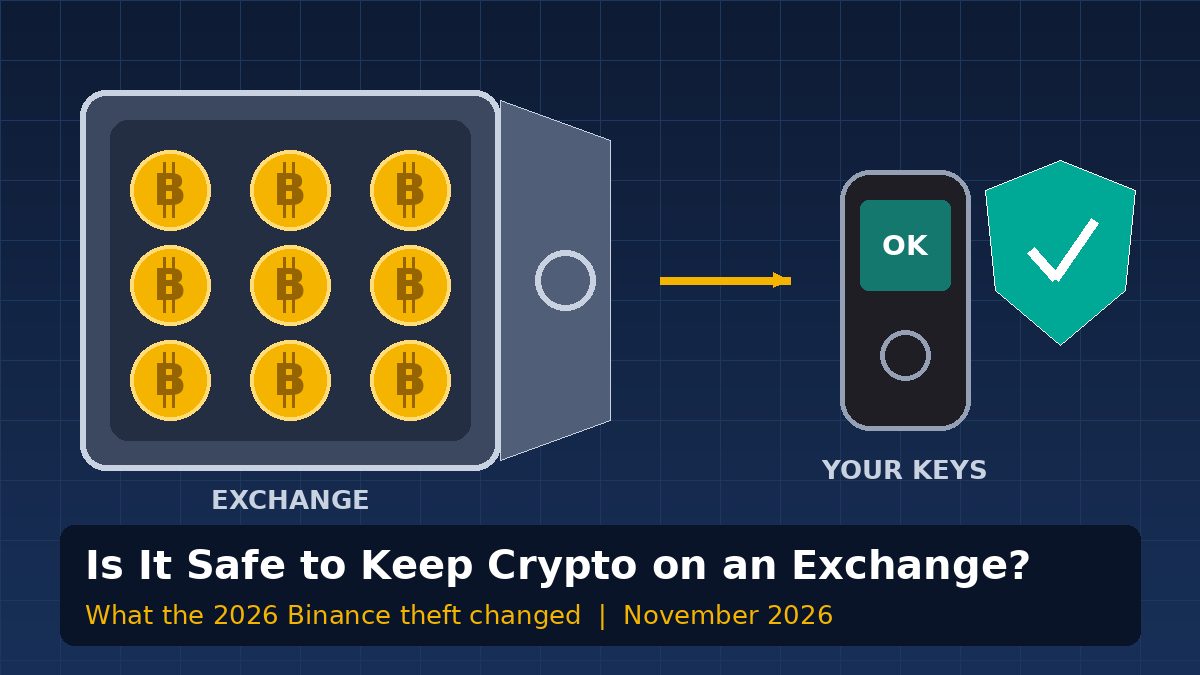
Is it safe to keep crypto on an exchange? For small amounts you trade often, it can be a reasonable risk, but it is never risk-free. The exchange holds the keys, FDIC and SIPC do not cover your crypto, and the October 29, 2026 Binance theft showed even the largest platform can be hacked.
Last updated November 21, 2026. Every figure below links to its source; recovery efforts are still ongoing.
What it means when an exchange holds your crypto
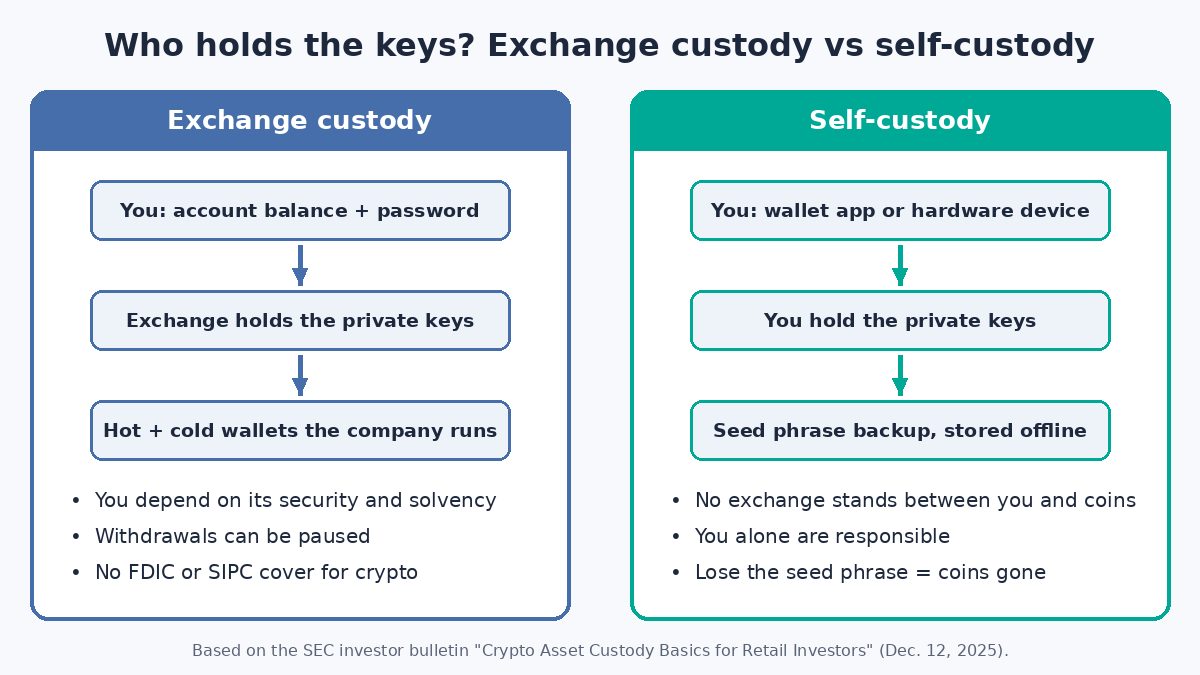
When you buy coins on an exchange and leave them there, the exchange usually holds the private keys. You see a balance in your account, but the coins sit in wallets the company controls. The SEC’s investor bulletin on custody puts it plainly: if a third-party custodian “is hacked, shuts down, or goes bankrupt, you may lose access to your crypto assets” (SEC investor bulletin).
The same bulletin warns that some custodians lend out customer coins (called rehypothecation) or mix them together instead of holding them for each customer separately. Before you leave a large balance anywhere, ask how the platform stores your coins and whether it uses them for its own purposes.
This is not a new risk. The exchange in our 2014 story of how we got started in cryptocurrency has since closed, and our 2014 guide to entering the Bitcoin world already pointed to the Mt. Gox bankruptcy after a hack.
What the October 2026 Binance theft showed
On October 29, 2026, attackers took about $6.3 billion in crypto from Binance’s hot wallets, the online wallets an exchange uses for day-to-day withdrawals. Binance says the attacker gained unauthorized access to an internal wallet signing service and moved funds outside its normal withdrawal process (Binance). Chainalysis called it the largest theft in crypto history and linked it to North Korea’s TraderTraitor group (Chainalysis).
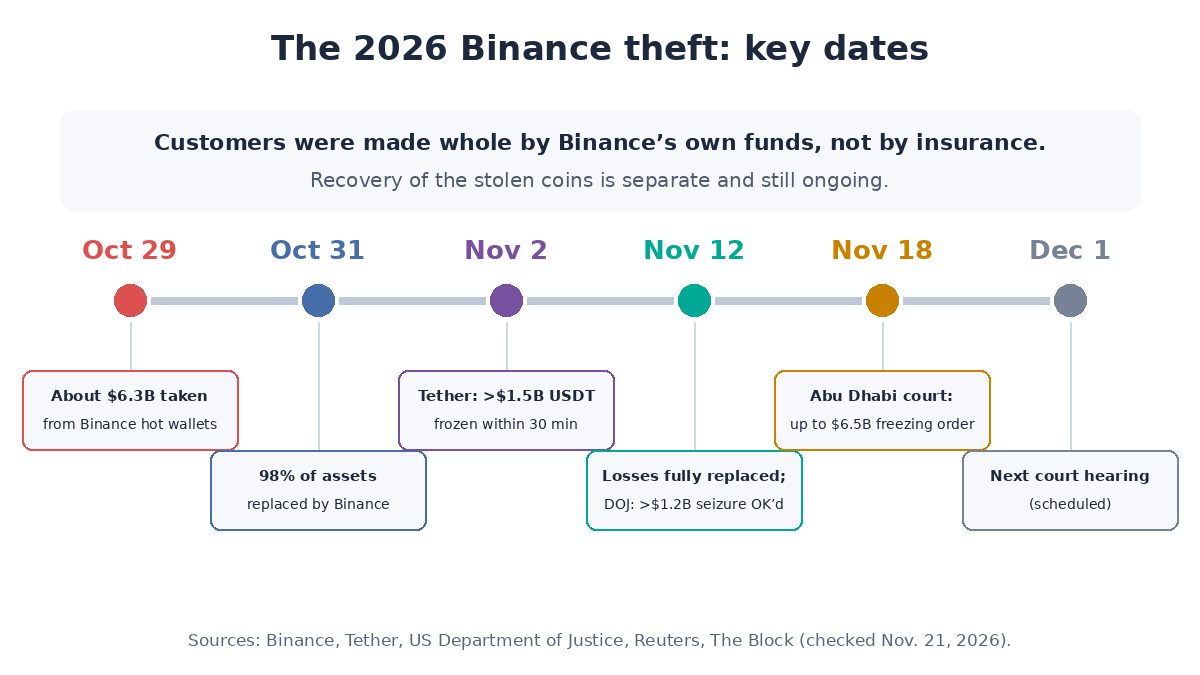
- October 31: Binance said 98% of the affected assets had already been replenished, with Binance absorbing the loss rather than its users (Binance).
- November 2: Tether said it froze more than $1.5 billion in stolen USDT within 30 minutes of the attack (Tether).
- November 12: Binance said it had fully restored the stolen customer assets (Investing.com). The same day, the Justice Department said government and private efforts had frozen more than $2.7 billion, and that it had court approval to seize or restrain more than $1.2 billion of that (DOJ).
- November 18: Binance announced a worldwide freezing order of up to $6.5 billion from the Abu Dhabi Global Market Courts. A separate order requires 18 companies, which are not accused of wrongdoing, to keep specific stolen assets frozen pending further proceedings, with a hearing set for December 1 (The Block; Reuters).
What “the exchange covered the losses” does and does not mean
Binance customers were made whole because Binance chose to absorb the loss and had the money to do it. It drew on an emergency fund for users, surplus from its futures insurance fund and its corporate treasury (CoinDesk). That was a company decision, not insurance or a legal guarantee, and a smaller exchange might not be able to pay a loss of that size.
Getting stolen coins back is a separate, slower process. A freeze does not decide who owns the assets, and Tether can reissue frozen USDT while bitcoin and ether have no comparable mechanism (CoinDesk). Withdrawals were also suspended while Binance contained the attack (Binance), which is exactly when you might want your coins.
Are funds on an exchange insured?
Not in the way a bank account is. The FDIC insures deposits at insured banks, with a standard amount of $250,000 per depositor, per bank, for each ownership category (FDIC). It says deposit insurance does not apply to crypto assets, does not protect against theft or fraud, and does not cover the failure of crypto exchanges, custodians or wallet providers (FDIC fact sheet).
SIPC protects up to $500,000 in securities and cash, including $250,000 in cash, at a failed member brokerage. It states that it “does not protect any digital or crypto asset that does not qualify as a ‘security’” under federal law (SIPC). Some exchanges describe private insurance; read exactly what it covers, because it may not cover your individual account.
What is proof of reserves, and does it protect you?
Proof of reserves is a report meant to show that an exchange holds enough assets to match customer balances. Binance pointed users to its Proof of Reserves page to show that the replaced assets were in place (Binance). That is useful, but the SEC warns that such reports are not audits and do “not tell investors the whole story about the entity’s liabilities” (SEC investor bulletin). Treat proof of reserves as one good sign, not a guarantee.
Exchange vs hardware wallet vs software wallet
| Exchange account | Hardware wallet | Software wallet | |
|---|---|---|---|
| Who holds the keys | The exchange | You, on an offline device | You, on a phone or computer |
| Main risks | Hacks, withdrawal pauses, company failure, account takeover | Losing the device and backup, phishing, fake devices | Malware, phishing, a lost phone without a backup |
| If something goes wrong | Depends on the company; no FDIC or SIPC cover for crypto | Restore from your seed phrase; nobody else can | Restore from your seed phrase; nobody else can |
| Best for | Buying, selling, small trading balances | Long-term holdings | Small amounts you spend or move often |
| Cost | Trading and withdrawal fees | Device price plus network fees | Usually free, plus network fees |
How to decide what to move off an exchange
There is no single right split. These steps help you decide for yourself.
Disclosure: Some links in this article are, or may become, affiliate links. If you sign up or buy through them, Cryptolix may earn a commission at no extra cost to you. This never changes what we recommend. See our Affiliate Disclosure. This article is for education only and is not financial advice. As an Amazon Associate, Cryptolix earns from qualifying purchases.
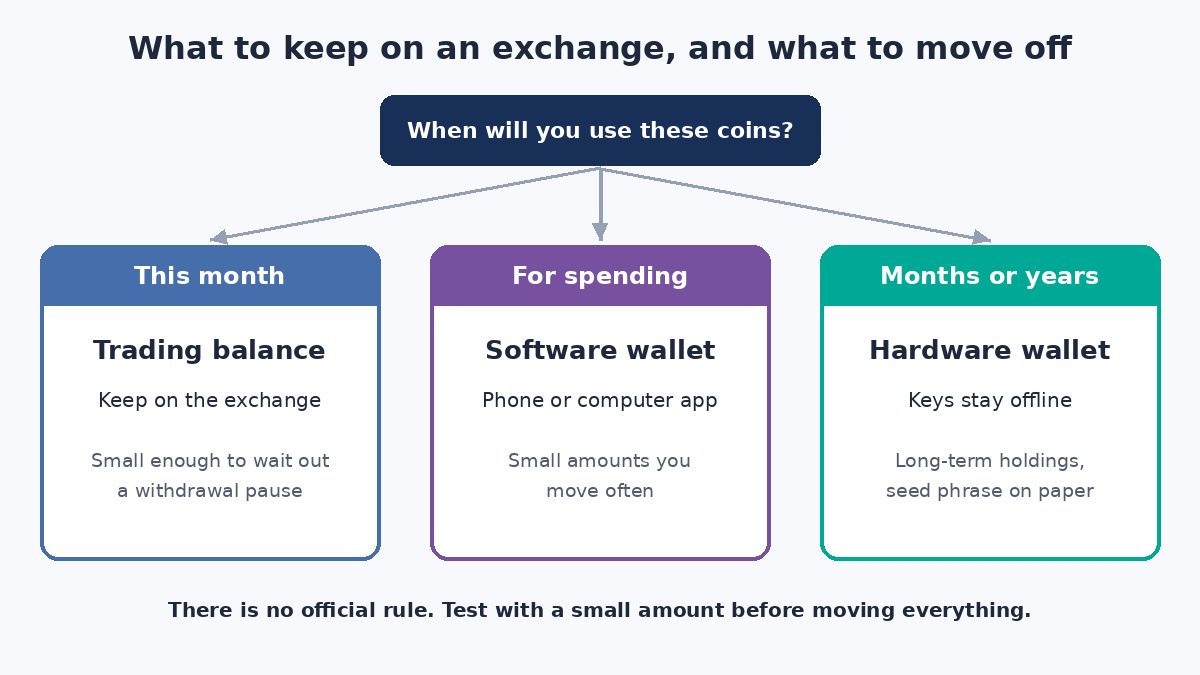
- Sort your coins into “trading” and “holding.” Trading coins are what you expect to buy or sell in the next few weeks. Holding coins are everything else.
- Size the exchange balance. Keep only the trading amount there, and only as much as you could manage without if withdrawals were paused for several days.
- Choose a wallet you control for the rest. For larger, long-term holdings, a hardware wallet such as Ledger or Trezor keeps the keys offline. Buy from the official site, not a marketplace reseller.
- Write down the seed phrase on paper. Store it offline and never photograph it, type it into a website or share it with anyone.
- Send a small test first. Withdraw a small amount, confirm it arrives, then move the rest. Check the address and network every time.
- Lock down the account you keep. Use a unique password and app-based two-factor authentication, and turn on a withdrawal address allowlist if your exchange offers one.
- Review every few months. Move profits you plan to keep off the exchange.
For buying and selling, established US exchanges such as Coinbase, Kraken and Gemini are common on-ramps. Treat any exchange as a place to buy and trade, not as a long-term vault.
Is it safe to keep crypto on Coinbase, Kraken, Binance or Robinhood?
The same logic applies to every brand. No exchange can promise your coins are safe, and none of them makes crypto FDIC or SIPC insured. Before you leave money on any platform, check that it is licensed to serve where you live, read how it stores customer coins, look for regular proof-of-reserves reports and turn on every security feature it offers. Our cryptocurrency trading tips compare types of exchanges and list common scams to avoid.
Is self-custody always safer?
Not automatically. Self-custody removes the exchange’s risk but hands the whole job to you. The SEC notes that if you lose your private key, you permanently lose access, and cold wallets can be lost, damaged or stolen (SEC investor bulletin). Scammers also target self-custody users with fake support messages asking for seed phrases. Start with a small amount, practise a restore, then move more.
Video: “Not your keys, not your coins” explained
In this 2019 Q&A, Andreas M. Antonopoulos, co-author of Mastering Bitcoin, explains why holding your own keys matters and what you give up when someone else holds them. It predates the Binance theft, but the principle has not changed.
Checklist: before you leave crypto on an exchange
- ☐ I know which of my coins are for trading and which are for holding.
- ☐ My exchange balance is small enough that a withdrawal pause would not hurt me.
- ☐ I understand that FDIC and SIPC do not cover my crypto.
- ☐ I have read how the exchange stores and uses customer coins.
- ☐ My account has a unique password and app-based two-factor authentication.
- ☐ Long-term coins are in a wallet I control, with the seed phrase written down offline.
- ☐ I tested a small withdrawal before moving a large amount.
- ☐ I will never share my seed phrase, even with “support.”
Frequently asked questions
Is it safe to keep crypto on Coinbase, Kraken or Binance?
No exchange can promise that. Large exchanges spend heavily on security, but the October 29, 2026 Binance theft showed that hot wallets can still be drained. Keep only what you trade on any exchange and move long-term holdings to a wallet you control.
How much crypto is safe to leave on an exchange?
There is no official number. A practical rule is to keep only what you plan to trade soon and could manage without if withdrawals were paused for days. Coins you plan to hold for months belong in a wallet you control.
Is crypto on an exchange FDIC or SIPC insured?
No. The FDIC says deposit insurance does not cover crypto assets or the failure of crypto companies. SIPC does not protect digital assets that do not qualify as securities under federal law. Ask your exchange how any cash balance is held.
What is proof of reserves, and does it protect me?
It is a report meant to show that an exchange holds assets matching customer balances at a point in time. It helps, but the SEC warns that these reports are not audits and do not show a company’s full liabilities. It is not insurance.
Is self-custody always safer?
Not always. Self-custody removes the exchange’s risk but makes you responsible. If you lose your seed phrase, or a scammer gets it, nobody can restore your coins. Start with a small amount, practise, then move larger holdings.
This article is for education only and is not financial, legal or tax advice. Crypto can lose value, and no storage method removes every risk.
Sources
- Binance: 29 October 2026 Security Incident, Initial Findings and Response Update (Nov. 3, 2026)
- Chainalysis: Binance hack, tracing the theft to North Korea (Oct. 30, 2026)
- Investing.com: Binance restores all $6.3 billion stolen in October hack (Nov. 12, 2026)
- US Department of Justice: actions to disrupt North Korea’s theft of cryptocurrency (Nov. 12, 2026)
- Tether: freezes over $1.5 billion from Binance hack (Nov. 2, 2026)
- The Block: Binance obtains $6.5 billion freezing order from Abu Dhabi court (Nov. 18, 2026)
- Reuters via Investing.com: UAE court orders freeze on crypto tokens stolen from Binance wallets (Nov. 18, 2026)
- CoinDesk: Binance wins $6.5 billion freezing order (Nov. 19, 2026)
- Cointelegraph: court documents show breakdown of tokens lost in Binance hack (Nov. 19, 2026)
- FDIC: Fact sheet on deposit insurance and crypto companies
- FDIC: Understanding deposit insurance
- SIPC: What SIPC protects
- SEC investor bulletin: Crypto asset custody basics for retail investors (Dec. 12, 2025)
- SEC investor bulletin: caution with alternatives to financial statement audits, including proof of reserves (July 27, 2023)